If You Can See Grey, It Means the Colour Didn’t Work
The Truth
This belief is subtle, but powerful.
That if any grey is visible after a colour service, something has gone wrong.
The colour didn’t take.
The formula wasn’t strong enough.
The job is incomplete.
So the instinct becomes immediate:
Fix it. Cover it. Eliminate it completely.
But what if that visibility is not a flaw?
What if it is part of the design?
Why This Myth Exists
For many years, success in hair colour was measured by uniformity.
No variation.
No inconsistency.
No grey visible at all.
A perfectly even result became the standard.
And anything outside of that was seen as a mistake.
But this standard was built around control.
Not necessarily around what looks most natural.
The Expert Insight
When every strand is brought to the same level and tone, the result becomes flat.
Even if technically correct.
Because natural hair does not behave that way.
It contains variation.
Subtle shifts in tone.
Areas of lightness.
Areas of depth.
Grey hair, when left in small, controlled amounts, can act as part of that variation.
It can reflect light.
Create softness.
Break up density.
This is where modern colour approaches differ.
They do not aim to remove all grey.
They aim to integrate it.
Using systems like Pure Colour, colour can be applied with intention—allowing certain areas to remain lighter while refining others.
The result is not incomplete.
It is composed.
The Difference Between Visibility and Contrast
There is an important distinction here.
Visible grey is not the issue.
Harsh contrast is.
When grey appears as a strong, defined line against darker colour, it draws attention.
It feels disconnected.
But when grey is diffused—softened into the surrounding tones—it becomes part of the overall look.
It no longer reads as regrowth.
It reads as dimension.
What Happens When We Over-Correct
When the goal is to eliminate every grey strand, colour becomes heavier.
More saturated.
More uniform.
And over time, this can lead to:
- loss of light reflection
- increased density in the ends
- more noticeable regrowth lines
Which then requires more frequent correction.
This is the cycle many clients find themselves in.
Not because the grey is the problem.
But because the approach is.
The Role of Placement
Where colour is applied matters as much as what is applied.
Certain areas may require more depth.
Others benefit from remaining lighter.
Around the face, for example, allowing softness can enhance the overall look.
Rather than creating a solid frame, it creates movement.
This is not accidental.
It is intentional placement.
The Role of Haircutting
The haircut supports this entirely.
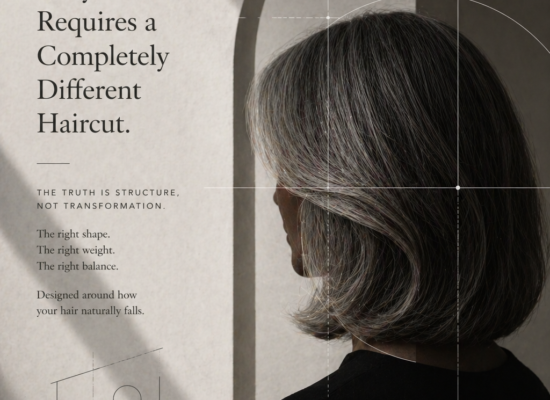
Through the Shizen method, the structure of the hair is designed to allow variation to show.
Weight is balanced.
Movement is created.
The hair separates naturally.
This allows lighter pieces—whether grey or refined tone—to sit within the shape.
Not on top of it.
Without the right structure, even well-placed colour can feel disconnected.
The Philosophy
This belief—that everything must be covered—comes from a desire for perfection.
But perfection, in hair, often removes character.
It removes subtlety.
It removes the small variations that make something feel real.
This is where the philosophy of Wabi Sabi becomes relevant again.
Not as an aesthetic choice.
But as a way of understanding beauty.
That small variations are not imperfections.
They are what create interest.
A Shift in Perspective
Instead of asking:
“Why can I still see grey?”
A more useful question is:
“Does the overall result feel balanced?”
Because balance is what determines whether something feels complete.
Not uniformity.
When the colour, shape, and movement work together, the presence of grey becomes secondary.
It no longer stands out.
It supports.
A More Refined Outcome
When this approach is applied correctly, the result feels different.
Not overly coloured.
Not overly controlled.
But considered.
The hair moves.
It reflects light.
It evolves without harsh lines.
And the presence of grey becomes part of that experience.
Not something to remove.
But something to work with.
Closing
If you’re curious how this approach is applied in practice, you can explore the Private Atelier here:
Enjoyed this article?