There is a quiet moment at the beginning of every appointment.
You sit.
You look into the mirror.
And the conversation begins.
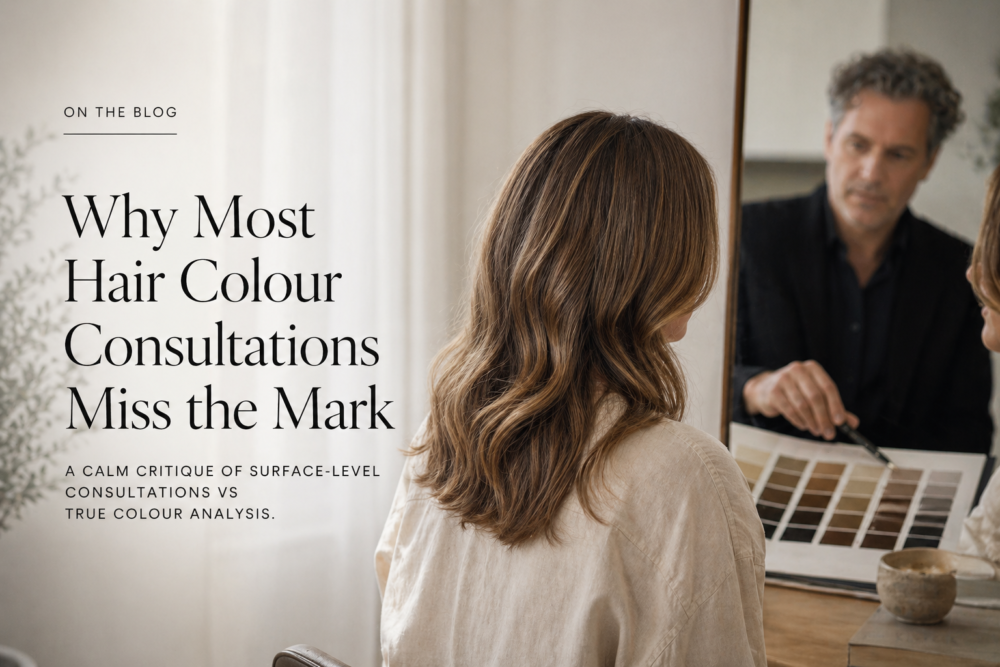
In many salons, this moment moves quickly. A few questions are asked. A reference photo is shown. A colour is suggested.
And within minutes, a decision is made.
On the surface, this feels efficient. Professional, even.
But this is where most colour consultations begin to miss the mark.
The Myth of the “Quick Consultation”
The modern salon has been shaped by speed.
Time slots. Service menus. Predictable outcomes.
Within this structure, the consultation often becomes a formality—a step to move through, rather than a space to truly understand.
You may be asked:
- “Do you want to be lighter or darker?”
- “Warm or cool?”
- “Do you have a photo?”
These questions are not wrong. But they are incomplete.
Because they assume something fundamental:
That hair colour is a choice made in isolation.
The Truth Beneath the Surface
Hair colour does not exist on its own.
It sits against your skin.
It interacts with your eyes.
It responds to light, movement, and time.
Two people can wear the same “shade,” and it will never look the same.
Yet many consultations are built around selecting a colour first—and understanding the person second.
This is where the disconnect begins.
You may leave with a colour that is technically correct, even beautifully executed… but something still feels slightly off.
Not wrong.
Just not fully aligned.
Why This Happens So Often
There are a few reasons this pattern has become so common.
1. The Industry Has Been Taught to Prioritise Results Over Relationship
Education often focuses on formulas, techniques, and outcomes.
How to achieve a tone.
How to correct a colour.
How to replicate a look.
But less attention is given to observation.
To understanding how colour behaves on an individual, rather than how it is applied.
2. Reference Images Create False Certainty
A photo can be helpful. It gives language to something that can be difficult to describe.
But it also introduces a subtle problem.
It suggests that the goal is to recreate something that already exists—on someone else.
Different skin tone.
Different natural depth.
Different contrast.
The image becomes the target, rather than the person in the chair.
3. “Warm vs Cool” Has Been Oversimplified
Many consultations reduce colour to a binary:
Warm or cool.
But this is only the beginning of a much deeper conversation.
There are layers of softness, intensity, depth, and contrast that sit beyond this simple distinction.
When we reduce colour to two options, we limit what is possible—and often miss what is most harmonious.
What a Thoughtful Consultation Actually Looks Like
A true consultation is not rushed.
It is observational.
Intentional.
Quietly detailed.
Before any colour is discussed, the focus shifts to you.
- The undertone of your skin
- The clarity or softness in your features
- The natural level of your hair
- The contrast between your skin, eyes, and hair
These elements form a foundation.
From here, colour is not chosen—it is revealed.
Before your appointment, take my free Seasonal Colour Quiz to reflect on your natural colouring and wardrobe preferences. You can download a one-page guide with a suggested season, hair colour level and hue to bring to your consultation, where we can refine the direction around your hair and lifestyle.
The Role of Colour Analysis
This is where structured colour analysis becomes invaluable.
Using tools such as The Colourist Board, the process becomes less about preference and more about alignment.
Instead of asking:
“What colour do you want?”
The question becomes:
“What tones already exist within you—and how can we honour them?”
This subtle shift changes everything.
Because when colour is aligned with your natural palette:
- It enhances rather than competes
- It softens rather than overwhelms
- It grows out with more grace
- It feels effortless to wear
The Difference You Can Feel
The most interesting part of this process is not what you see—it’s what you feel.
Clients often describe it in similar ways:
- “It just looks like me, but better.”
- “I don’t feel like I have to try as hard.”
- “It still looks good weeks later.”
This is not coincidence.
It is the result of working with your natural characteristics, rather than against them.
Colour as a Long-Term Decision
When consultation is rushed, colour becomes a short-term result.
Something to maintain.
To fix.
To adjust.
But when consultation is thoughtful, colour becomes a long-term decision.
It evolves with you.
It softens over time.
It requires less correction, less effort.
This is where longevity begins.
A Different Philosophy
In my work, colour is never the starting point.
Observation is.
There is a belief, often unspoken, that transformation must be dramatic to be valuable.
I see it differently.
The most refined results are often the most subtle.
A tone that sits quietly in harmony.
A colour that doesn’t draw attention to itself—but enhances everything around it.
This approach is deeply influenced by the philosophy of Wabi Sabi.
Beauty not as perfection, but as alignment.
Not imposed, but discovered.
A Final Thought
A consultation is not just a conversation about hair.
It is a moment of understanding.
When it is rushed, the result may still be good.
But when it is given the time and attention it deserves, the result becomes something else entirely.
Something that feels considered.
Personal.
Enduring.
If you’re curious how this philosophy is applied in practice, you can explore the Private Atelier here:
Enjoyed this article?