There is a quiet shift happening in how we approach beauty.
Away from trends.
Away from imitation.
And back toward something more considered.
Something more personal.
In hair, this shift often begins with a single realisation:
Not every beautiful colour is right for every person.
And more importantly—when a colour is right, you feel it immediately.
This is where personal colour analysis begins.
The Misunderstanding Around Colour
Most people have experienced some version of this:
You leave the salon with a colour that looks good.
Technically well done. Even admired by others.
And yet, something feels slightly disconnected.
You find yourself adjusting your makeup.
Changing what you wear.
Trying to make the colour “work.”
This is not a failure of skill.
It is a misalignment.
Because colour is not simply about what looks good in isolation.
It is about what harmonises with you.
So, What Is Personal Colour Analysis?
At its simplest, personal colour analysis is the study of how colour interacts with your natural features.
Not just your hair.
But your:
- Skin tone
- Eye colour
- Natural depth
- Contrast between features
It is the understanding that every person carries a unique palette—and that the most beautiful results come from working within it.
Rather than imposing colour, we observe what already exists.
To begin exploring your own palette, take my free Seasonal Colour Quiz. Answer questions about your skin, eyes, natural hair and wardrobe preferences, then download a one-page guide with a suggested season, hair colour level and hue. Your result is a starting point to refine through personal consultation.
Why It Matters More Than You Think
When colour is chosen without analysis, it often relies on:
- Trends
- Reference images
- Habit
- Personal preference
These can produce beautiful results.
But they can also create tension.
A colour that competes with your skin.
A tone that feels too heavy, or too light.
A result that looks striking at first—but doesn’t settle over time.
When colour is aligned with your natural palette, something different happens.
It becomes effortless.
You don’t have to adjust to it.
It adjusts to you.
Beyond “Warm vs Cool”
One of the reasons colour analysis can feel confusing is because it is often simplified too much.
You may have heard:
“You’re warm.”
“You’re cool.”
While this can be a useful starting point, it is only a small part of a much larger picture.
True colour analysis considers:
- Softness vs clarity — Are your features muted or defined?
- Depth — Do you suit lighter or deeper tones?
- Contrast — Is there a strong difference between your skin, hair, and eyes, or is it more blended?
These elements shape how colour behaves on you.
Two people can both be “warm,” yet require completely different tones to feel balanced.
The Role of Observation
At its core, personal colour analysis is not about rules.
It is about observation.
The way certain tones brighten your complexion.
The way others create shadow or dullness.
The subtle shift in how your features come forward—or recede.
This is why the process cannot be rushed.
It requires stillness.
Attention.
A willingness to see, rather than assume.
A Structured Approach to Understanding Colour
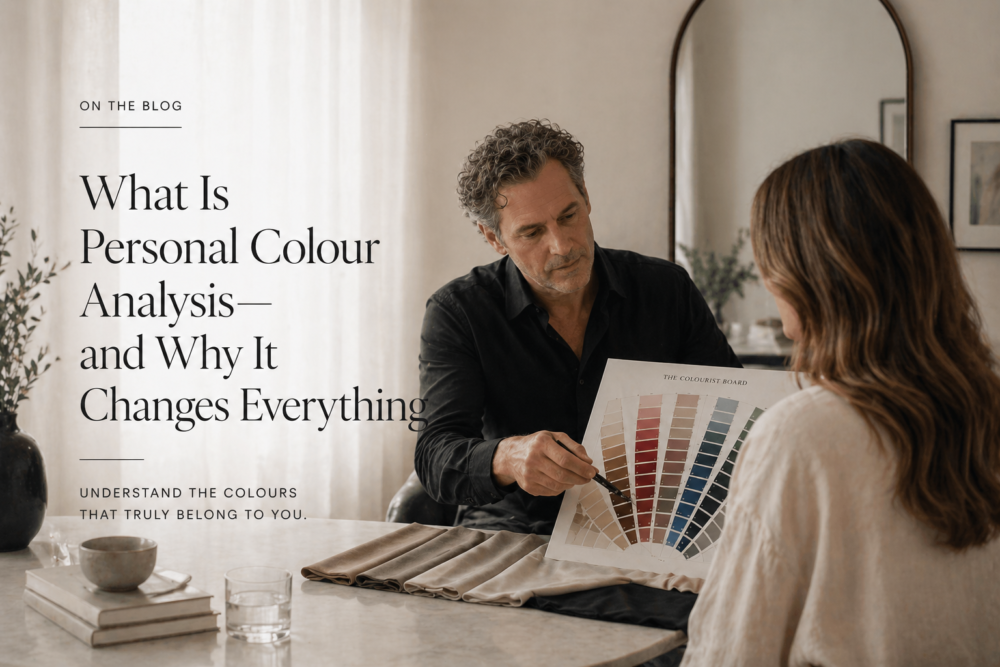
To bring clarity to this process, I work with The Colourist Board.
It provides a visual framework that allows us to:
- Compare tones directly against your natural features
- Identify what harmonises, and what disrupts
- Build a palette that feels cohesive and intentional
This removes guesswork.
And replaces it with quiet certainty.
What Changes When Colour Is Aligned
The difference is often subtle—but deeply felt.
Clients notice that:
- Their skin appears more even and luminous
- Their eyes feel clearer, more defined
- Their overall look becomes softer, more refined
But beyond appearance, something else shifts.
There is a sense of ease.
The colour doesn’t need to be managed or justified.
It simply belongs.
Longevity Over Impact
One of the most overlooked benefits of colour analysis is longevity.
When colour is chosen in harmony with your natural palette:
- Regrowth is softer
- Fading is more graceful
- Maintenance becomes less demanding
The result is not just beautiful on the day—it remains beautiful over time.
This is where true luxury exists.
Not in intensity.
But in endurance.
A Different Way of Thinking About Colour
There is a common belief that transformation must be bold to be meaningful.
But the most powerful changes are often the ones that feel almost invisible.
A tone that feels like it was always meant to be there.
A colour that enhances, rather than announces.
This is where personal colour analysis becomes more than a technique.
It becomes a philosophy.
One that aligns closely with Wabi Sabi:
Beauty found in harmony.
In restraint.
In what already exists.
A Final Thought
Personal colour analysis is not about limitation.
It is about clarity.
It removes the noise of trends, opinions, and assumptions—and replaces it with something far more reliable:
Understanding.
When you understand what works for you, colour becomes simpler.
More refined.
More personal.
More enduring.
If you’re curious how this philosophy is applied in practice, you can explore the Private Atelier here:
Enjoyed this article?