There is a quiet detail that is often overlooked in hair colour.
Not the formula.
Not the technique.
But the person sitting in the chair.
Because before colour is ever applied, something far more important is already present:
A natural balance.
Between your skin.
Your eyes.
Your hair.
And when this balance is understood, colour becomes effortless.
Looking Before Choosing
Most colour decisions begin with a question:
“What would you like to do today?”
It is a reasonable place to start.
But it assumes that preference alone is enough to guide the outcome.
A more considered approach begins differently.
Not with a decision.
But with observation.
The Skin: The Foundation of Everything
Your skin is the largest and most influential element in how colour is perceived.
It reflects light.
It carries undertones.
It sets the overall tone for everything around it.
When hair colour works with the skin, something subtle happens:
The complexion appears more even.
Softer.
More luminous.
When it works against it:
Shadows can appear.
Redness can be emphasised.
The overall effect can feel slightly unsettled.
This is why skin is always the starting point.
The Eyes: A Point of Clarity
Eyes often carry a clarity that the rest of the face may not.
They can be soft and blended.
Or bright and defined.
This clarity influences how much intensity a hair colour can hold.
If the eyes are soft, a highly intense colour may feel overpowering.
If the eyes are clear and defined, overly muted tones can feel flat.
Hair colour, when chosen well, supports the eyes.
It does not compete with them.
Contrast: The Relationship Between Elements
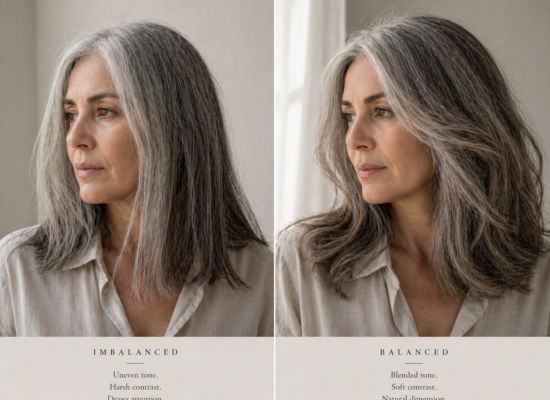
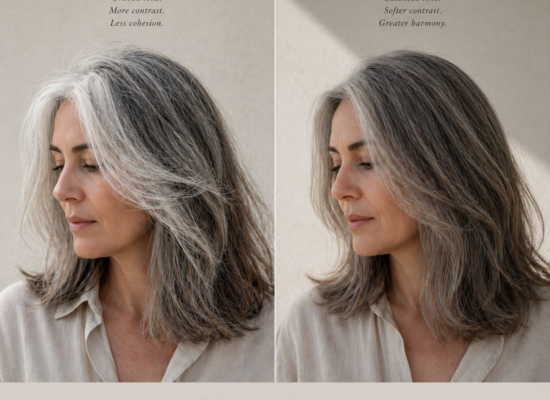
Contrast is one of the most important—and least understood—elements of colour.
It refers to the difference between your skin, hair, and eyes.
Some people have high contrast:
Light skin with darker hair, for example.
Others have low contrast:
Everything sitting within a similar tonal range.
Neither is better.
But each requires a different approach.
High Contrast
Higher contrast can support more definition in the colour.
Deeper tones.
Clearer placement.
More structure.
When done well, this creates elegance and strength.
When overdone, it can feel harsh.
Low Contrast
Lower contrast benefits from softness.
Gentle transitions.
Blended tones.
A more diffused finish.
When respected, this creates refinement.
When ignored, colour can feel too heavy or disconnected.
Why These Elements Matter Together
Skin, eyes, and contrast are not separate considerations.
They work together.
A shift in one influences the others.
For example:
A lighter colour may soften contrast.
A deeper tone may increase it.
A warmer shade may enhance certain undertones in the skin.
This is why colour cannot be chosen in isolation.
It must be considered as part of a whole.
Moving Beyond Assumption
It is easy to make assumptions about colour.
Based on trends.
Past experiences.
Or what has worked before.
But as your features evolve—through light, age, or the introduction of grey—so too should your colour.
What once felt right may begin to feel slightly off.
This is not a problem.
It is an invitation to look again.
A Structured Way to See Clearly
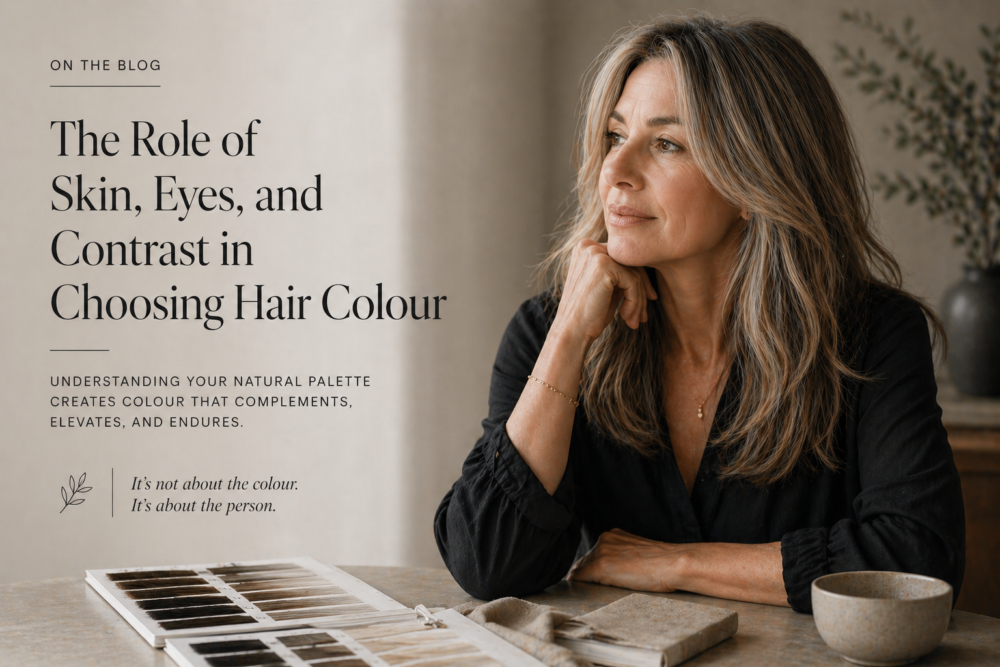
To bring clarity to this process, I use The Colourist Board.
It allows us to observe how different tones interact with your skin, eyes, and contrast in real time.
Not through theory.
But through direct comparison.
This creates a level of precision that removes guesswork—and replaces it with understanding.
The Result: Quiet Alignment
When colour is chosen with these elements in mind, the result is rarely dramatic.
It is refined.
Subtle.
Quietly effective.
Your skin appears more even.
Your eyes feel more present.
The overall balance of your features is restored.
Nothing feels forced.
A Philosophy of Observation
This approach requires a shift in mindset.
From choosing colour…
To seeing clearly.
From imposing change…
To revealing what already exists.
It is less about creativity in the traditional sense—and more about restraint.
About knowing when to add, and when to leave something as it is.
A Final Thought
Hair colour is not just about hair.
It is about how all elements of your appearance come together.
When skin, eyes, and contrast are understood, colour becomes simpler.
More intentional.
More personal.
More enduring.
And in that simplicity, something powerful emerges:
A sense that everything is working in quiet harmony.
If you’re curious how this philosophy is applied in practice, you can explore the Private Atelier here:
Enjoyed this article?