Frizz Means Your Hair Is Damaged
The Truth
Frizz is often treated as a problem.
Something to smooth.
Control.
Eliminate.
And it is usually associated with damage.
That if the hair is frizzy, it must be unhealthy.
But frizz is not always a sign of damage.
It is often a sign of movement.
The Expert Insight
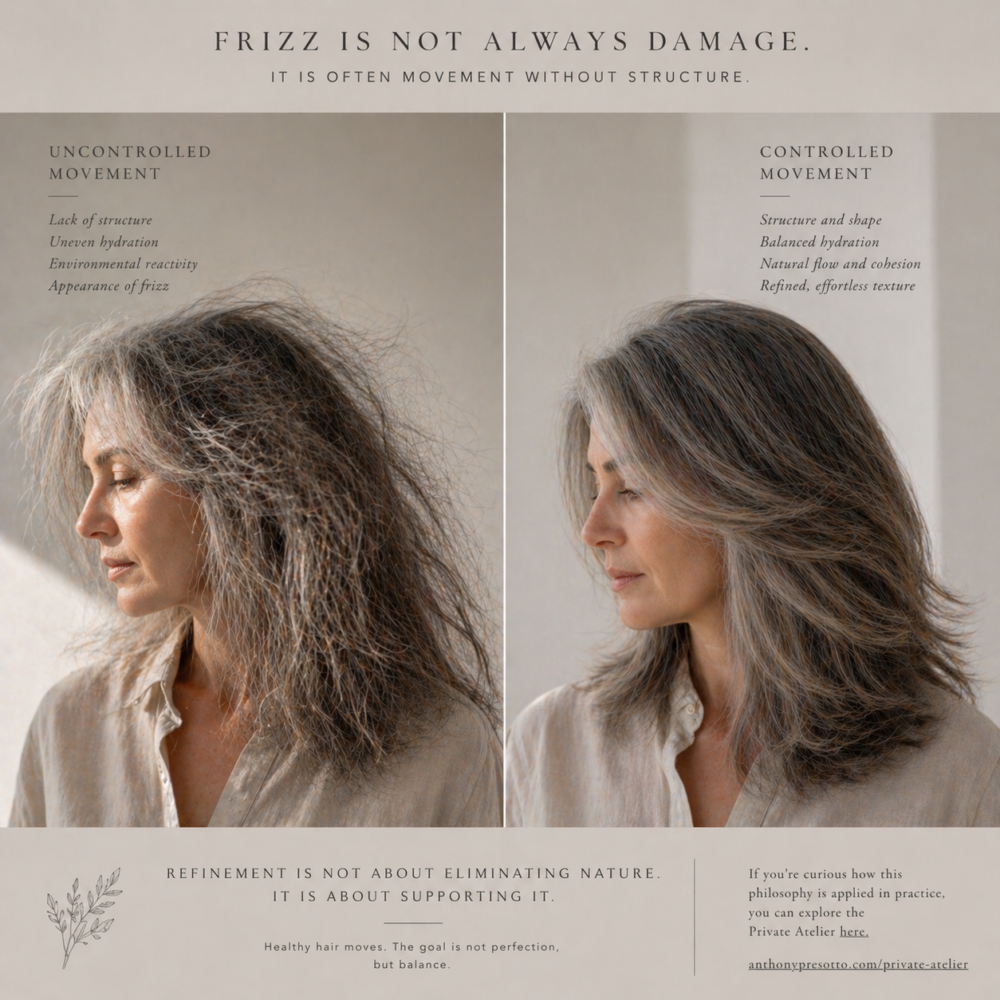
Frizz appears when the hair is not moving as a single unit.
Individual fibres separate.
They respond differently to moisture in the air.
They expand at different rates.
This creates what we perceive as frizz.
But this can happen in healthy hair.
Especially when:
- the hair has natural texture
- humidity is present
- the structure allows separation
Damage can increase frizz.
But not all frizz is damage.
Sometimes, it is simply the hair behaving naturally.
The Role of Structure
Hair that lacks structure will appear more frizzy.
Because there is no cohesion.
No clear direction.
Through the Shizen method, the haircut creates alignment.
Weight is placed with intention.
The hair falls together.
Movement is guided.
This reduces uncontrolled separation.
Not by forcing the hair to be smooth.
But by giving it a way to move cohesively.
The Role of Hydration
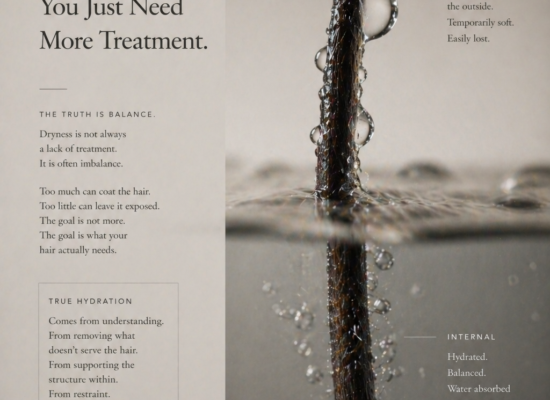
Hydration influences how the hair responds to the environment.
When the hair is balanced, it absorbs moisture evenly.
When it is not, some areas expand more than others.
This creates inconsistency.
Using systems like Pure Haircare and Juuce, hydration is restored without heaviness.
The hair becomes more consistent.
More predictable.
The Role of Control
The instinct is often to eliminate frizz completely.
Using heat.
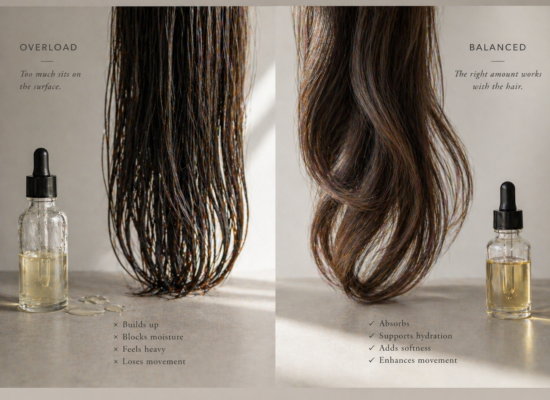
Heavy products.
Smoothing techniques.
But this can remove movement.
And movement is what gives hair life.
The goal is not to eliminate frizz entirely.
It is to refine it.
To allow the hair to move.
Without becoming chaotic.
The Philosophy
This myth comes from associating imperfection with damage.
Seeing variation…
And assuming something is wrong.
But variation is part of natural hair.
The goal is not perfection.
It is balance.
Frizz, when understood, is not a flaw.
It is information.
A signal of how the hair is behaving.
A Different Perspective
Instead of asking:
“How do I get rid of frizz?”
A more useful question becomes:
“Is my hair moving in a way that feels controlled and natural?”
Because when movement is supported, frizz becomes softer.
Less aggressive.
More integrated.
Closing
If you’re curious how this philosophy is applied in practice, you can explore the Private Atelier here:
Enjoyed this article?