There is a moment, a few weeks after your appointment, when the truth of a colour begins to reveal itself.
The initial gloss has softened.
The tone has shifted slightly.
The light catches it differently now.
For some, the colour becomes even more beautiful.
For others, something begins to feel off.
Flat.
Dull.
Uneven.
This is often described as “fading.”
But fading, in itself, is not the problem.
In fact, all colour fades.
The difference lies in how it fades.
The Misunderstanding Around Fade
Most people are taught to think of fading as failure.
A loss of tone.
A loss of vibrancy.
Something to correct as quickly as possible.
But this perspective misses something important.
Fading is not just a chemical process.
It is a visual one.
And the way a colour fades is largely determined before it is ever applied.
Colour Is Designed, Not Just Applied
When a colour is chosen without considering the individual, it may look beautiful on the day.
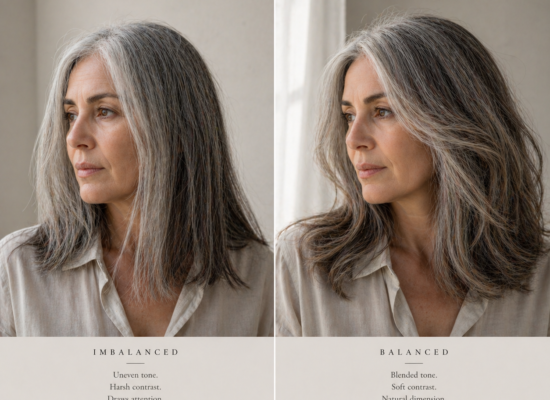
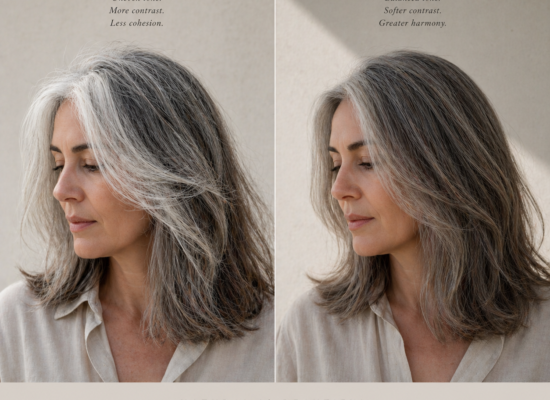
But as it begins to soften, the underlying imbalance becomes more visible.
Warm tones can become brassy.
Cool tones can become flat or grey.
Depth can feel too heavy, or too hollow.
This is not because the colour was poorly executed.
It is because it was not fully aligned.
The Role of Natural Harmony
When a colour sits in harmony with your natural features, it fades differently.
More gently.
More evenly.
More gracefully.
Because as the artificial pigment softens, it reveals tones that are already connected to you.
Your natural warmth.
Your softness.
Your depth.
The transition feels seamless.
Why Some Colours Become Brassy
Brassiness is one of the most common concerns.
But it is often misunderstood.
Hair naturally contains warm underlying pigments.
When colour fades, these underlying tones become more visible.
If the original colour was not designed to work with this warmth, it can feel excessive.
Too gold.
Too orange.
Too obvious.
But when warmth is considered from the beginning—rather than corrected later—it can become part of the overall harmony.
Why Some Colours Become Flat
On the opposite end, some colours lose their vitality.
They can appear:
Dull.
Matte.
Lacking dimension.
This often happens when colour is pushed too far toward coolness or neutrality without considering the individual’s natural clarity.
As the tone fades, what remains can feel lifeless.
Again, not wrong.
Just disconnected.
The Importance of Depth
Depth plays a significant role in how colour evolves.
A tone that is too deep may hold pigment unevenly, creating heaviness as it fades.
A tone that is too light may lose structure quickly, leaving the hair feeling hollow.
When depth is aligned with your natural level, fading becomes more controlled.
More balanced.
More refined.
A More Considered Approach to Colour Selection
To create colour that fades beautifully, the decision must begin with observation.
Not trend.
Not assumption.
Not habit.
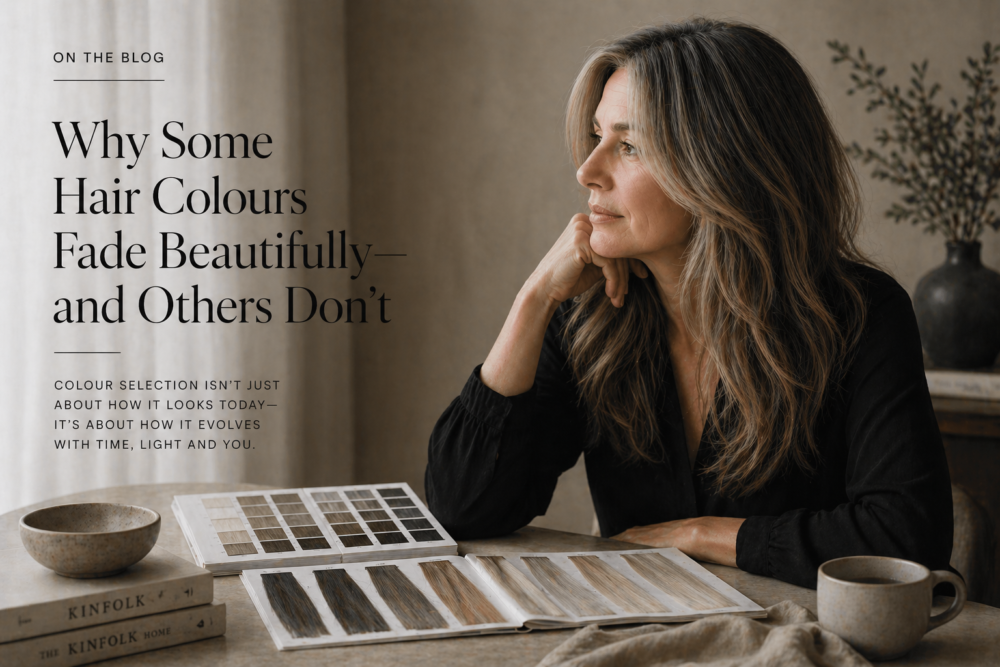
This is where tools such as The Colourist Board become essential.
They allow us to:
- Identify the tones that already exist within you
- Understand how your hair will respond over time
- Build a colour that evolves in harmony with your natural palette
This is not about preventing fade.
It is about guiding it.
Designing for Longevity
When colour is approached with longevity in mind, the goal changes.
It is no longer just:
“How will this look today?”
But:
“How will this look in three weeks?
In six weeks?
In three months?”
The most refined colour is not the one that looks perfect on the day.
It is the one that continues to feel right long after you leave the salon.
The Feeling of Effortless Colour
When colour fades well, something subtle happens.
You stop thinking about it.
There is no urgency to correct.
No need to adjust.
It simply continues to work.
This is the quiet difference between colour that is applied—and colour that is considered.
A Philosophy of Time
There is a certain patience required to create colour that ages well.
It asks for restraint.
For a willingness to choose what is right, rather than what is immediate.
This aligns closely with the philosophy of Wabi Sabi.
Beauty that evolves.
That softens.
That becomes more interesting with time.
A Final Thought
Fading is inevitable.
But dissatisfaction is not.
When colour is chosen with care, it does not deteriorate.
It transitions.
And in that transition, something important is revealed:
Whether the colour was ever truly in harmony to begin with.
If you’re curious how this philosophy is applied in practice, you can explore the Private Atelier here:
Enjoyed this article?