Covering Grey Hair Is the Best Solution
The Truth
For decades, women have been told that grey hair is something to hide.
The solution has always been presented as simple:
cover it completely, make it disappear, restore the original colour.
And for a long time, that approach made sense.
When grey first appears, it can feel unfamiliar. It disrupts the colour you’ve known for years. It can feel like something is “wrong” that needs correcting.
So full coverage became the default.
A single, solid colour. From roots to ends. No grey visible.
But here is what most people don’t realise:
That solution was never designed for longevity.
It was designed for control.
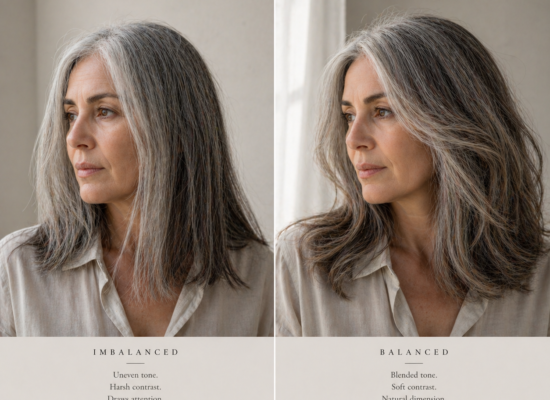
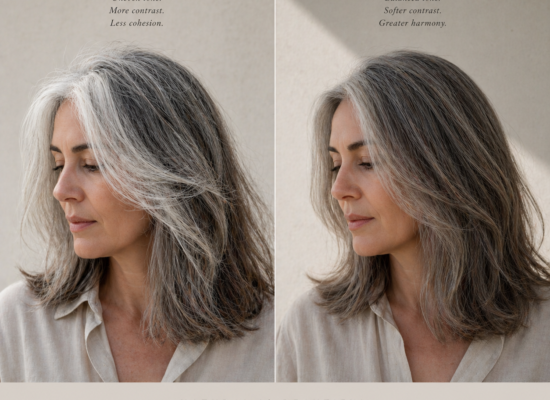
Because while full grey coverage creates a uniform colour, it also creates a very clear contrast when your natural hair begins to grow again.
And that contrast is where the cycle begins.
The Cycle No One Talks About
Once you fully cover grey hair, you commit to maintaining it.
Every 3–4 weeks, the regrowth appears.
A visible line between your natural hair and the colour that was applied.
That line becomes the problem.
Not the grey itself.
So the solution becomes more frequent appointments. More colour. More effort to maintain something that is constantly working against you.
This is why so many women describe their hair as “high maintenance.”
Not because their hair is difficult.
But because the strategy is.
The Expert Insight
Grey hair is not actually grey.
It is hair that has lost pigment.
What you are seeing is light interacting with a strand that no longer contains melanin.
Which means something important:
Grey hair reflects light differently.
It can appear softer. Brighter. More translucent.
And when you apply a single, flat colour over that, you remove that natural variation.
You replace something dynamic with something uniform.
This is why fully covered hair can sometimes feel heavier, flatter, or less alive.
Not because the colour is wrong.
But because it is too consistent.
In contrast, modern approaches like grey blending work differently.
They don’t aim to eliminate the grey.
They integrate it.
Using a combination of depth, tone, and placement, the grey becomes part of the overall composition rather than something that needs to be hidden.
The result is softer.
More dimensional.
And importantly—more forgiving as it grows.
Why This Matters More Over Time
In the early stages of greying, full coverage can feel effective.
It restores familiarity.
It creates a clean, predictable result.
But as grey increases, something shifts.
The maintenance becomes more frequent.
The contrast becomes stronger.
The colour often becomes darker and heavier over time as layers build.
And eventually, many women find themselves asking the same question:
“Why does my hair feel harder to manage than it used to?”
The answer is rarely the hair.
It’s the approach.
Because when colour is used to control rather than complement, it creates resistance.
Whereas when colour is used to soften, the hair begins to work with you.
The Philosophy
This is where my approach differs.
I don’t see grey hair as something to remove.
I see it as something to refine.
Because beauty, in its most natural form, is not about perfection.
It’s about balance.
This is deeply aligned with the philosophy of Wabi Sabi—the idea that beauty exists in subtle variation, softness, and the passage of time.
Grey hair is not a flaw in that philosophy.
It is part of it.
When approached with intention, it can add lightness to the face.
Softness to the overall colour.
And a sense of ease that cannot be created with heavy, uniform tones.
This is why I often say:
Colour should not be applied.
It should be composed.
A Different Way Forward
This does not mean grey coverage is wrong.
There are situations where it is appropriate.
But it is no longer the only option.
And for many women, it is no longer the most elegant one.
A softer approach—one that blends, refines, and evolves with your natural hair—offers something different:
- less visible regrowth
- more flexibility between appointments
- a more natural, lived-in result
And perhaps most importantly:
A relationship with your hair that feels easier.
Not harder.
The Quiet Shift
What we are seeing now is not a trend.
It is a shift in thinking.
Away from control.
Towards harmony.
Away from maintenance.
Towards longevity.
Away from covering.
Towards refining.
And once you experience that shift, it becomes very difficult to go back.
If you’re curious how this philosophy is applied in practice, you can explore the Private Atelier here:
Enjoyed this article?