If Your Colour Fades Quickly, It Means It Wasn’t Done Properly
It is one of the most common concerns people have after colouring their hair.
“My colour faded quickly. Was something done wrong?”
It is an understandable question.
However, the answer is often more nuanced than it first appears.
Hair colour fading does not necessarily mean the colour was applied incorrectly.
In many cases, it reflects the natural behaviour of the hair itself.
Why This Myth Exists
When colour fades sooner than expected, it can feel disappointing.
The assumption is that colour should remain consistent for a fixed period of time.
When it does not, it is easy to assume that something has gone wrong in the process.
However, hair does not behave in a uniform way.
Each person’s hair has its own structure, history, and condition. These variables influence how colour is absorbed and how it is retained over time.
The Expert Insight
One of the most important factors in colour longevity is porosity.
Porous hair has a more open structure. This allows colour to enter the hair easily, but it also allows colour to leave more quickly.
Hair that has been previously coloured, lightened, or exposed to environmental stress often becomes more porous.
This means that even when colour is applied with precision, it may fade more quickly than expected.
Other factors also play a role:
• the natural base colour of the hair
• the percentage of grey hair
• the tone being applied
• the condition of the hair fibre
Even external elements such as frequent washing, heat styling, and sun exposure can influence how colour evolves.
Understanding Colour as a Living Process
Hair colour is not static.
It is a living process that changes over time.
Pigment shifts. Tone softens. Light reflects differently as the hair is exposed to daily life.
Rather than aiming for colour that remains identical from day one to week six, a more refined approach is to design colour that evolves beautifully.
This means considering not only how the colour looks immediately after application, but how it will look as it softens.
The Difference Between Fading and Flow
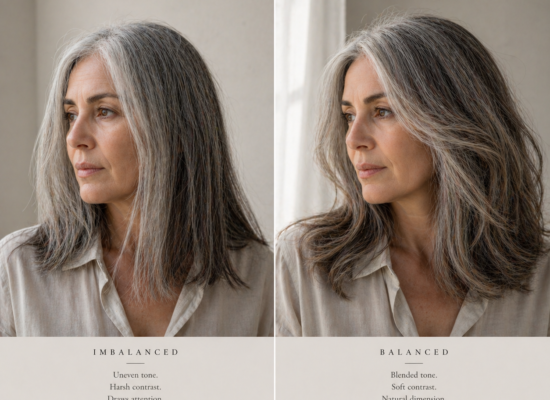
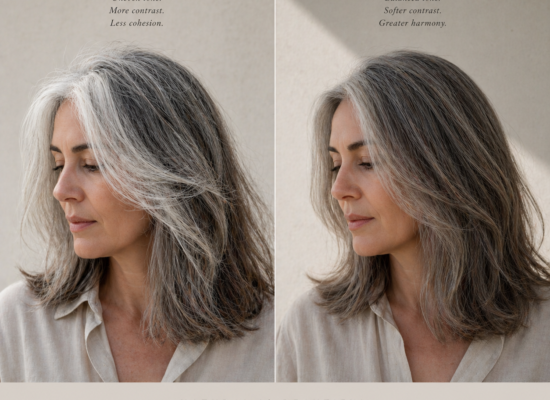
There is an important distinction between colour that fades poorly and colour that evolves gracefully.
Poor fading often appears uneven or dull.
Well-crafted colour fades softly. The transition is gradual, and the hair maintains a sense of balance and harmony.
This is where technique becomes important.
Colour can be designed to move naturally as it fades, allowing the hair to retain a refined appearance for longer.
A Philosophy of Longevity
In the atelier, the goal is not to create colour that appears perfect for a moment.
The goal is to create colour that remains beautiful over time.
This approach values longevity over immediacy.
It recognises that hair is part of everyday life. It is washed, styled, exposed to the elements, and constantly in motion.
Colour should be able to move with it.
Beauty in Change
There is a quiet beauty in hair that evolves naturally.
As tone softens and light shifts, the hair takes on a slightly different character.
When this process is guided with intention, it does not feel like loss.
It feels like movement.
If you’re curious how this philosophy is applied in practice, you can explore the Private Atelier here.
Enjoyed this article?