The Darker You Go, the Better Grey Hair Is Covered
The Truth
This belief feels logical.
If grey hair is lighter, then going darker should cover it more effectively.
Stronger contrast.
More pigment.
Better coverage.
And in the short term, it often appears to work.
The grey disappears.
The colour looks rich.
The result feels complete.
But over time, something begins to shift.
The colour can start to feel heavy.
The regrowth becomes more noticeable.
And the overall effect can feel less natural than intended.
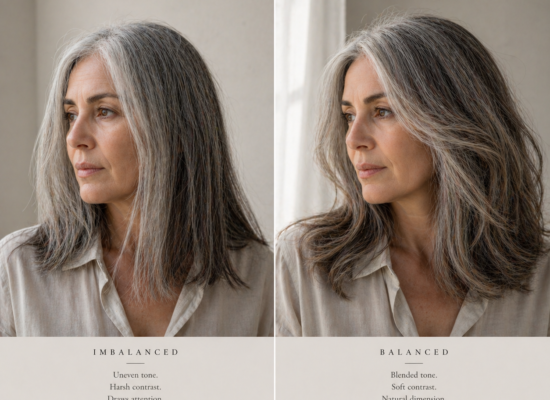
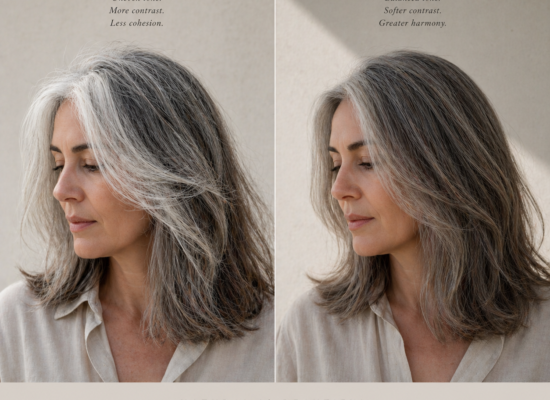
Because while darker colour may hide grey more completely, it also creates a stronger visual contrast as the hair grows.
And that contrast is what eventually becomes the problem.
Why This Myth Exists
Traditional colour systems were designed around control.
If something is lighter, you add depth to neutralise it.
If something is uneven, you make it uniform.
So when grey appears, the instinct is to restore depth.
To bring the hair back to what it once was.
But hair does not exist in isolation.
It interacts with skin tone.
With light.
With the natural variation already present in the hair.
When we go too dark, we don’t just cover grey.
We change the entire balance.
The Expert Insight
Grey hair behaves differently to pigmented hair.
It is more resistant.
More reflective.
Often slightly different in texture.
When you apply a darker colour across everything, two things happen.
First, the grey becomes saturated with pigment.
Second, the rest of the hair becomes darker than it naturally wants to be.
This creates a uniform result—but not always a harmonious one.
Because natural hair is never one flat tone.
It contains depth and lightness.
When everything is taken darker, that variation disappears.
The hair can begin to look dense.
Less dimensional.
Less responsive to light.
This is where modern colour approaches differ.
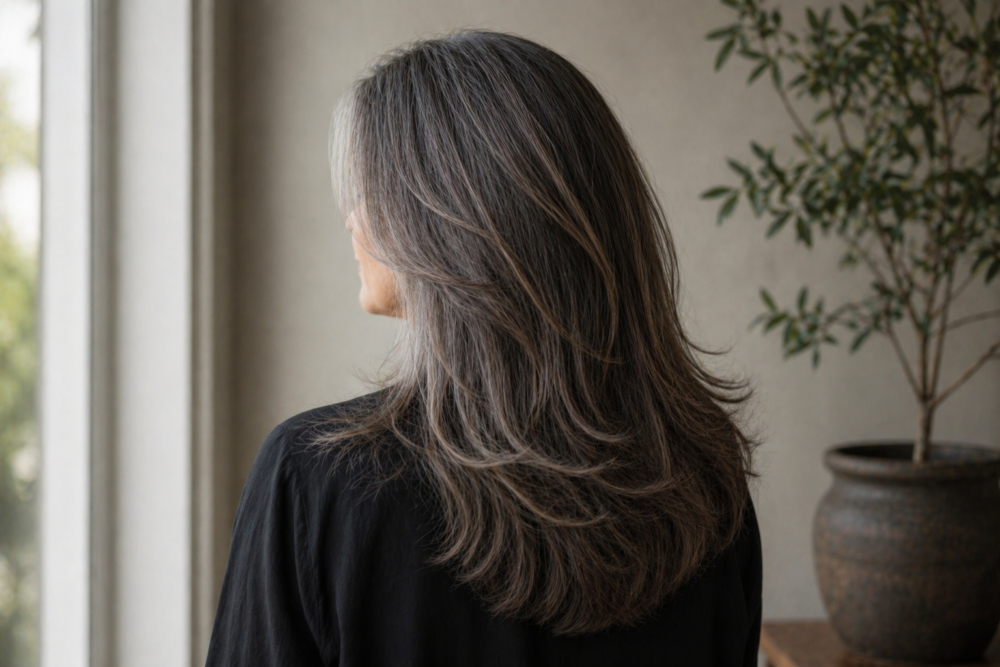
Instead of increasing depth everywhere, they balance depth with light.
Using systems like Pure Colour, particularly demi-permanent and low-ammonia ranges, allows for controlled refinement rather than full saturation.
The goal is not to overpower the grey.
It is to place depth only where it is needed—and allow light to remain where it creates softness.
What Happens Over Time
The darker the colour, the stronger the regrowth contrast.
This is where many clients begin to feel trapped.
At first, the darker result feels polished.
But as the natural hair grows, the line between the two becomes more defined.
More obvious.
More difficult to ignore.
So appointments become more frequent.
The colour becomes more layered.
And often, even darker over time as previous colour builds.
This is how hair gradually moves away from natural.
Not suddenly.
But slowly, through repetition.
The Alternative Approach
Instead of asking:
“How dark do we need to go to cover this?”
A more refined question is:
“How much depth is actually needed?”
Because in many cases, it is less than you think.
Grey does not always need to be fully covered to feel balanced.
It needs to be diffused.
Integrated into the surrounding tones.
When depth is used selectively—rather than globally—the result becomes lighter.
More dimensional.
More forgiving as it grows.
And importantly, more aligned with how the hair naturally behaves.
The Role of Light
Light is often overlooked in colour conversations.
But it is central to how hair is perceived.
Darker hair absorbs light.
Lighter and varied tones reflect it.
When the hair reflects light, it creates movement.
Softness.
A sense of effortlessness.
When everything is darkened, that reflection is reduced.
The hair can appear flatter, even if the colour itself is technically correct.
This is why subtle variation is so important.
It allows the hair to respond to its environment.
To change slightly depending on how light falls.
Which is what gives it life.
The Role of Shape
Again, colour cannot do this alone.
The haircut must support the way light moves through the hair.
Through the Shizen method, the structure is designed to create natural separation and flow.
Weight is not removed randomly.
It is positioned intentionally.
This allows lighter pieces—whether natural grey or refined tones—to sit in a way that catches light.
Not artificially.
But organically.
When shape and colour are aligned, the need for heavy colour diminishes.
Because the haircut is already doing part of the work.
The Philosophy
This belief—that darker equals better—comes from a desire for certainty.
A clear, controlled outcome.
But refinement rarely comes from extremes.
It comes from balance.
From knowing when to add—and when to hold back.
This is where the philosophy of restraint becomes important.
Not doing less for the sake of it.
But doing only what is necessary.
And no more.
Grey hair does not require dominance.
It requires understanding.
A Different Way to See It
Instead of using darkness to control the hair, consider using contrast more thoughtfully.
Not high contrast.
But subtle contrast.
A relationship between depth and light that feels natural.
Because when that balance is right, the hair does not feel coloured.
It feels composed.
And that distinction is what creates elegance.
Closing
If you’re curious how this approach is applied in practice, you can explore the Private Atelier here:
Enjoyed this article?