Hair Myth #2

Grey Blending and Grey Coverage Are the Same Thing

The Truth

At first glance, grey blending and grey coverage can look similar.

Both involve colour.
Both aim to soften the appearance of grey hair.
Both can create a more refined overall look.

So itโ€™s understandable why they are often grouped together.

But they are not the same.

Not in approach.
Not in outcome.
And certainly not in how they grow over time.

Grey coverage is about replacing what is there.

Grey blending is about working with it.

And that difference changes everything.


Why This Myth Exists

For many years, the industry has spoken about grey hair in very simple terms:

You either cover it, or you donโ€™t.

That binary thinking shaped how colour services were designed.

Full coverage became the standard because it delivered a clear, immediate result.
The grey disappeared. The hair looked uniform again.

It felt complete.

Grey blending, on the other hand, was often misunderstood.

Because it doesnโ€™t aim for perfection.

It aims for harmony.

And harmony is quieter.
Less obvious.
More subtle in its result.

Which is why many people donโ€™t realise itโ€™s even an option.


The Expert Insight

To understand the difference, you have to look at what each method is trying to achieve.

Grey coverage uses permanent colour to fully saturate the hair.

Every strand is brought to the same depth and tone.

The goal is consistency.

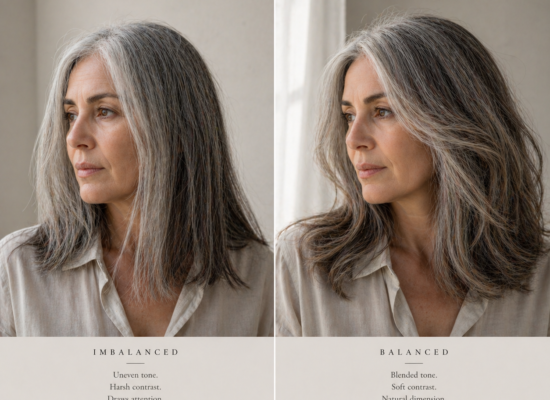
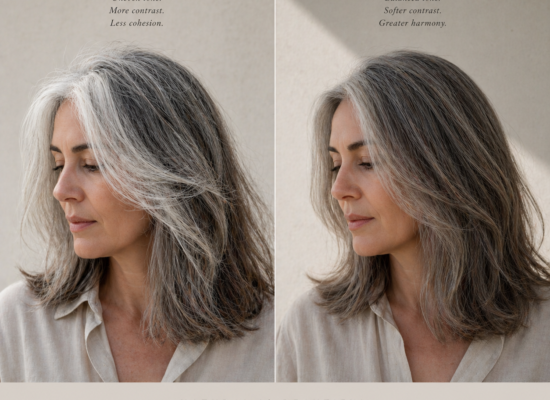
And while that consistency can look polished initially, it creates a strong contrast as the hair grows.

A visible regrowth line.

A clear separation between natural and coloured hair.

Grey blending takes a different approach.

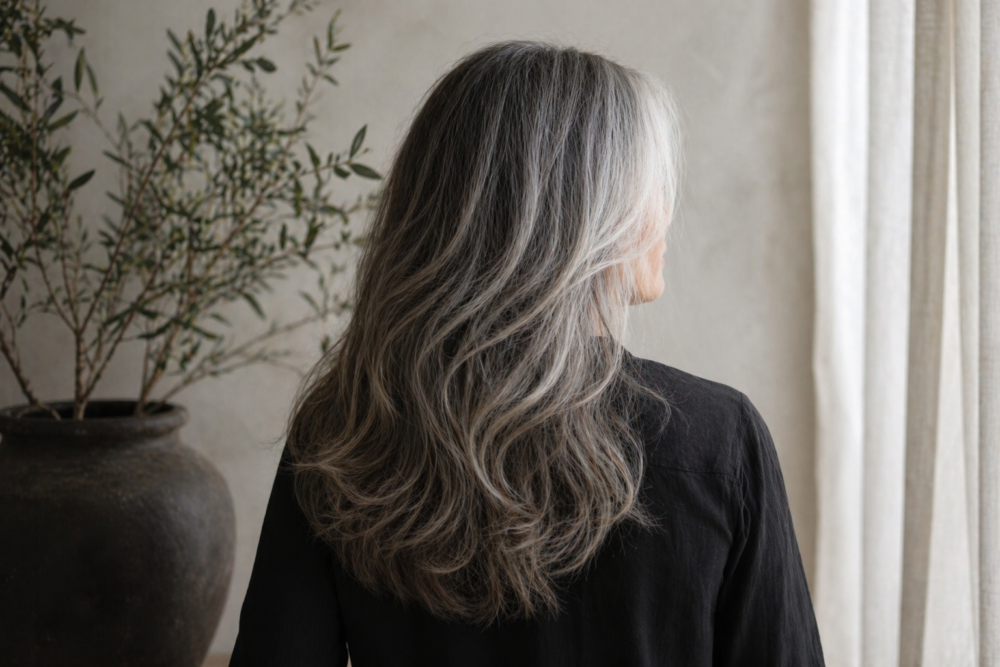
Instead of removing the grey, it diffuses it.

Using a combination of tone, translucency, and selective placement, the grey is softened into the surrounding colour.

Not erased.

Integrated.

This is where product choice becomes important.

Using ranges like Pure Colour, particularly systems like Evoke and Luminates, allows for this level of control.

Because they are designed to create softness, reflect light, and maintain the integrity of the hair rather than forcing uniformity.

The result is a colour that feels lighter, more dimensional, and more natural as it evolves.


What You See vs What You Feel

This is where the distinction becomes clearer.

With grey coverage:

  • The result is solid
  • The finish is consistent
  • The regrowth is defined

With grey blending:

  • The result is soft
  • The finish is dimensional
  • The regrowth is diffused

But the real difference is not just visual.

Itโ€™s experiential.

Clients who move from coverage to blending often describe the same shift:

Their hair feels easier.

Appointments feel less urgent.
The colour feels less โ€œheavy.โ€
The overall look feels more like them.

Not something applied over them.


Why This Matters Long Term

Grey hair is not static.

It increases over time.
It changes texture.
It interacts differently with light.

A method that relies on full control will always require more effort as that change continues.

More colour.
More frequency.
More maintenance.

Whereas a method that works with the hair allows it to evolve naturally.

Blending does not fight the process.

It adapts to it.

This is why, over time, grey blending often becomes the more sustainable approach.

Not because it does less.

But because it does exactly what is neededโ€”and no more.


The Role of Haircutting

This is where most conversations about grey colour stop.

But they shouldnโ€™t.

Because colour alone cannot create harmony.

Shape plays a critical role.

Through my Shizen approach to haircutting, the structure of the hair is designed to support how colour moves and reflects light.

Weight is placed intentionally.
Movement is created where it matters.
The hair is cut where it naturally lives.

This allows blended colour to breathe.

To move.

To feel effortless.

Without the right shape, even the most beautiful colour can feel incomplete.


The Philosophy

This difference reflects a deeper belief.

That hair should not be controlled into submission.

It should be understood.

Grey coverage is often driven by the desire to restore what was.

Grey blending is guided by the acceptance of what isโ€”and the refinement of it.

This is where the philosophy of Wabi Sabi becomes relevant again.

Not as an aesthetic trend.

But as a way of seeing.

Subtle variation.
Soft imperfection.
Natural evolution.

These are not things to correct.

They are things to work with.

And when you do, the result feels different.

Quieter.

More considered.

More enduring.


A More Refined Question

So instead of asking:

โ€œShould I cover my grey?โ€

A more useful question becomes:

โ€œWhat kind of relationship do I want with my hair?โ€

Do you want something that requires constant attention?

Or something that settles, softens, and evolves with you?

There is no right or wrong answer.

But there is a more aligned one.


If you’re curious how this philosophy is applied in practice, you can explore the Private Atelier here:


Enjoyed this article?