Grey Hair Is Coarse and Unmanageable
The Truth
This is something almost every woman has heard at some point.
That grey hair is wiry.
That it becomes coarse.
That it is more difficult to manage.
And while there is a small element of truth in how hair changes over time, the conclusion is often misunderstood.
Because grey hair itself is not the problem.
What changes is the structure.
And more importantly—the way it is treated.
Why This Myth Exists
As hair loses pigment, it also undergoes subtle structural changes.
The strand can feel drier.
It may reflect light differently.
It can appear slightly more textured.
These changes are real.
But they are often interpreted incorrectly.
Instead of adjusting the approach, the hair is labelled as “difficult.”
And once something is labelled that way, the response becomes more aggressive:
Heavier colour.
More product.
More control.
Which, in many cases, only reinforces the problem.
The Expert Insight
Grey hair is not inherently coarse.
What you are often feeling is a lack of internal moisture and flexibility.
Pigment plays a role in how the hair holds hydration.
When that pigment reduces, the hair can become more prone to dryness.
Dryness creates rigidity.
And rigidity is what we interpret as coarseness.
So the issue is not that the hair is thick or rough.
It is that it is less hydrated.
Less elastic.
Less responsive.
This is where product choice becomes critical.
Using ranges like Juuce and Pure Haircare, particularly moisture-focused and lamellar treatments, allows the hair to regain softness and movement.
Because when hydration is restored, the texture changes.
The hair begins to feel more flexible.
More fluid.
More alive.
What Actually Makes Hair Feel Unmanageable
It’s rarely the grey itself.
It’s the combination of:
- dehydration
- over-processing from repeated colouring
- haircuts that remove weight incorrectly
- styling routines that rely on force rather than structure
When these factors are present, the hair resists.
It becomes harder to control.
Not because it is stubborn.
But because it is out of balance.
The Role of Haircutting
This is where the conversation often needs to shift.
Because texture is not just a product issue.
It is a structural one.
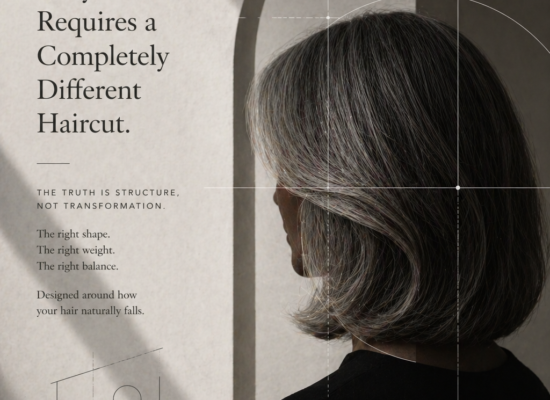
Through the Shizen method, hair is cut in a way that works with its natural behaviour.
Instead of forcing the hair into a shape, the shape is built around how the hair wants to fall.
Weight is placed with intention.
Bulk is reduced without disrupting flow.
Movement is created where it naturally occurs.
This allows the hair to settle.
To behave without constant intervention.
When this is done well, even hair that once felt “unmanageable” begins to feel effortless.
The Role of Colour
Colour also plays a part.
Heavy, repeated colour applications can reduce flexibility over time.
Particularly when the goal is full saturation.
In contrast, more refined approaches—using demi-permanent colour or gentle tonal adjustments—maintain the integrity of the hair.
They enhance rather than overwhelm.
This is where systems like Pure Colour become valuable.
Because they allow for subtlety.
For layering tone without compromising the structure of the hair.
Which supports manageability, rather than working against it.
The Shift in Approach
Instead of asking:
“Why is my hair becoming so difficult?”
A more useful question is:
“What does my hair need now that it didn’t need before?”
Because as hair evolves, the approach must evolve with it.
More hydration.
More thoughtful cutting.
More restraint in colour.
Not more force.
The Philosophy
There is a tendency to treat change as a problem to solve.
But in hair, change is constant.
And when approached correctly, it can lead to something better.
Grey hair is not a downgrade.
It is simply a different material.
And like any material, it responds to how it is handled.
With force, it resists.
With understanding, it settles.
This is where craft becomes important.
Not in doing more.
But in doing what is appropriate.
A Different Experience
When hydration, structure, and colour are aligned, something shifts.
The hair no longer feels like it needs to be managed.
It becomes something that supports you.
It moves more naturally.
It requires less effort.
It feels more predictable.
And that is what most people are actually looking for.
Not control.
But ease.
Closing
If you’re curious how this approach is applied in practice, you can explore the Private Atelier here:
Enjoyed this article?