If you have naturally curly hair, there’s a good chance you’ve spent years trying to control frizz.
Perhaps you’ve bought moisturising shampoos, deep conditioning treatments, curl creams, serums and oils, hoping that the next product will finally give you the soft, defined curls you’ve been looking for.
Sometimes they help.
Sometimes your hair looks beautiful for a day, only to become frizzy again the moment you step outside.
And sometimes adding more products simply leaves your curls feeling heavy, coated or lifeless.
After more than four decades as a hairdresser and educator, I’ve come to believe that one of the biggest misunderstandings about curly hair is the assumption that frizz always means your hair needs more moisture.
It doesn’t.
To understand frizz, we first need to understand the hair itself.
What Actually Causes Curly Hair to Become Frizzy?
Curly hair naturally bends, twists and changes direction along its length.
These characteristics influence how individual fibres interact, how curls group together and how the hair responds to moisture in the surrounding environment.
Frizz becomes visible when individual hairs separate from their curl group or move away from the overall shape.
There isn’t one single cause.
Frizz can be influenced by several factors, including:
- Humidity and changes in the surrounding environment
- The condition of the hair’s cuticle
- Chemical, thermal or mechanical damage
- Natural curl formation and individual hair characteristics
- Friction from brushing, towels and everyday handling
- Styling techniques and the products used
- The shape and weight distribution of the haircut
Understanding which factors are affecting your hair is far more useful than simply reaching for another moisturising product.
1. Humidity: Why Your Curls Change When You Step Outside
If you live in Brisbane or South East Queensland, you’ll know how dramatically humidity can affect your hair.
You might spend time carefully styling your curls in the morning, only to find that they expand, lose definition or become fluffy as the day progresses.
Hair fibres interact with water in the atmosphere.
As humidity changes, water can enter or leave the hair, influencing the temporary hydrogen bonds that help determine its shape.
This can alter the way individual fibres sit, causing some hairs to move away from their original curl formation.
The result can be increased volume, reduced definition and visible frizz.
Importantly, this can happen even when your hair is well-conditioned and in good condition.
Humidity-related frizz doesn’t automatically mean your hair is dry.
A suitable styling product that provides hold and helps resist humidity may be more useful than continually adding richer conditioners or oils.
And even then, no product can completely prevent hair from responding to its environment.
2. Dryness: When Your Hair Really Does Need Conditioning
Curly hair can be more prone to feeling dry, particularly through its lengths and ends.
The natural bends and twists of the hair can make the distribution of scalp oils along the fibre less straightforward.
But not all curly hair is equally dry, and curl pattern alone doesn’t determine how much conditioning a person needs.
Hair that feels rough, tangles easily, lacks flexibility or becomes difficult to manage may benefit from more appropriate conditioning.
A well-formulated conditioner can help reduce friction, improve softness and make the hair easier to detangle.
Depending on the condition of the hair, additional treatments may also be beneficial.
However, there’s an important distinction.
Conditioning helps improve the feel and manageability of hair. It doesn’t necessarily provide the hold needed to keep curls defined.
You can have beautifully conditioned hair that still becomes frizzy because the curls haven’t been adequately supported during styling.
3. Why More Oil Isn’t Always the Answer
One of the most common responses to frizzy hair is to apply more oil.
Hair oils can be useful.
Depending on their formulation, they may improve lubrication, reduce friction, add shine and help manage the appearance of flyaway hairs.
Some oils can also reduce aspects of water movement into the hair fibre.
But oil isn’t the same thing as moisture, and it doesn’t necessarily create curl definition.
Applying more oil to hair that already has adequate conditioning may simply make it feel greasy, heavy or separated.
This can be particularly noticeable with finer curls and waves, where excessive product weight can reduce volume and movement.
For some hair types, a small amount of oil is helpful.
For others, a lightweight conditioner and a styling product with suitable hold may produce a better result.
The important question isn’t whether oil is good or bad.
It’s whether your particular hair needs it.
4. The Missing Ingredient Might Be Hold
Sometimes curly hair doesn’t need more conditioning.
It needs a styling product that helps the curls maintain their formation as they dry.
When wet curls are encouraged to group together, styling products containing suitable film-forming ingredients can help support those curl groups.
Gels, mousses and other curl stylers can provide different levels of hold, depending on their formulation.
Some create a temporary firm cast as the hair dries.
That cast isn’t necessarily a sign that you’ve used too much product.
It can be part of the process that helps curls retain their definition.
Once the hair is completely dry, the cast can often be gently softened without excessively disturbing the curl pattern.
The result may be softer, more defined curls with less visible frizz.
Of course, the amount of hold needed varies.
Fine waves may respond beautifully to a lightweight mousse.
Thicker or more densely curled hair may benefit from a different combination of conditioning and styling products.
There’s no universal formula.
And that’s precisely why understanding your own hair matters.
5. Sometimes the Problem Is How You’re Styling Your Hair
Even the most suitable products can disappoint when the styling technique doesn’t support the natural curl pattern.
For example, repeatedly touching or separating curls while they’re drying can disrupt the curl groups that have formed.
Aggressive towel drying can increase friction and disturb the hair’s surface.
Brushing dry curls can separate individual fibres and create a fuller, less defined appearance.
None of these techniques is inherently wrong in every situation.
Some people deliberately brush out their curls to create softness and volume.
Others prefer highly defined curl groups.
The difference lies in understanding the result you’re trying to achieve.
If definition is your goal, you may find it helpful to:
- Apply suitable styling products while your hair is sufficiently wet.
- Encourage your curls to group together naturally.
- Remove excess water gently, without unnecessary friction.
- Allow your curls to dry with minimal disturbance.
- Once completely dry, gently soften any styling cast if desired.
These are useful starting principles rather than rules that everyone must follow.
The best routine is the one that works with your hair and your lifestyle.
6. Could Your Haircut Be Contributing to Frizz?
This is an area that deserves more attention.
A haircut cannot change the internal structure of your hair or eliminate humidity.
But the shape of your haircut can influence how your curls sit together, how weight is distributed and how the overall silhouette appears.
When curly hair is cut without considering its natural spring, density and movement, the resulting shape may feel unbalanced.
Some areas may expand more than others.
Layers may sit awkwardly.
Excessive removal of weight can sometimes make the hair appear more disconnected or difficult to control.
Conversely, too much weight in the wrong areas may prevent curls from moving as freely as they could.
This doesn’t mean curly hair should never be layered or that removing weight is always a mistake.
It means those decisions should be made with an understanding of the individual hair.
A considered haircut can support a more harmonious shape, even when some natural frizz remains. You can also read Why Curly Haircuts Go Wrong to learn how curl formation and shape work together.
The Shizen Method: Understanding Before Correcting
My approach to haircutting is guided by the Shizen Method, a philosophy inspired by Japanese ideas of naturalness, harmony and refined craftsmanship.
Within this philosophy is Nagare (流れ), meaning flow.
Nagare is about understanding how hair naturally grows, falls, bends and moves.
It’s relevant to every texture, from straight hair to tightly coiled curls.
When working with curly hair, I observe its natural formation, spring, density, weight and movement before deciding how to shape it.
The aim isn’t to force the hair into a predetermined style.
It’s to create a shape that respects its individual characteristics.
This philosophy also influences how I think about frizz.
Rather than automatically trying to eliminate every flyaway hair, I consider the relationship between natural texture, condition, styling and the result the client wants to achieve.
Because sometimes what we describe as frizz is simply part of the natural character of the hair.
And natural texture doesn’t always need correcting.
A Simpler Approach to Caring for Your Curls
One of the things I hear from people with curly hair is how overwhelming haircare can become.
There are so many products, techniques and conflicting recommendations that it’s easy to feel you’re doing something wrong.
I believe the best place to begin is with a few simple questions.
Does your hair feel dry, or does it simply lack definition?
Are your curls becoming frizzy because of humidity, or are they being disturbed during styling?
Does your hair need more conditioning, or would a different styling product provide better support?
Is your haircut helping your curls sit naturally, or making them more difficult to manage?
The answers won’t be identical for everyone.
But they can help you make more informed choices and avoid unnecessary products.
Beautiful curls shouldn’t require an exhausting routine.
They should be something you can understand, enjoy and live with.
Curly Hair, Grey Hair and Beautiful Ageing
As our hair changes throughout life, its texture, density and behaviour may change too.
Some women notice their curls becoming finer, coarser, drier or less predictable as they age.
Grey and silver hair can also have different characteristics from the pigmented hair growing alongside it.
However, grey hair isn’t automatically coarser or drier simply because it has lost pigment.
Individual differences, ageing, previous chemical services and the condition of the hair all play a role.
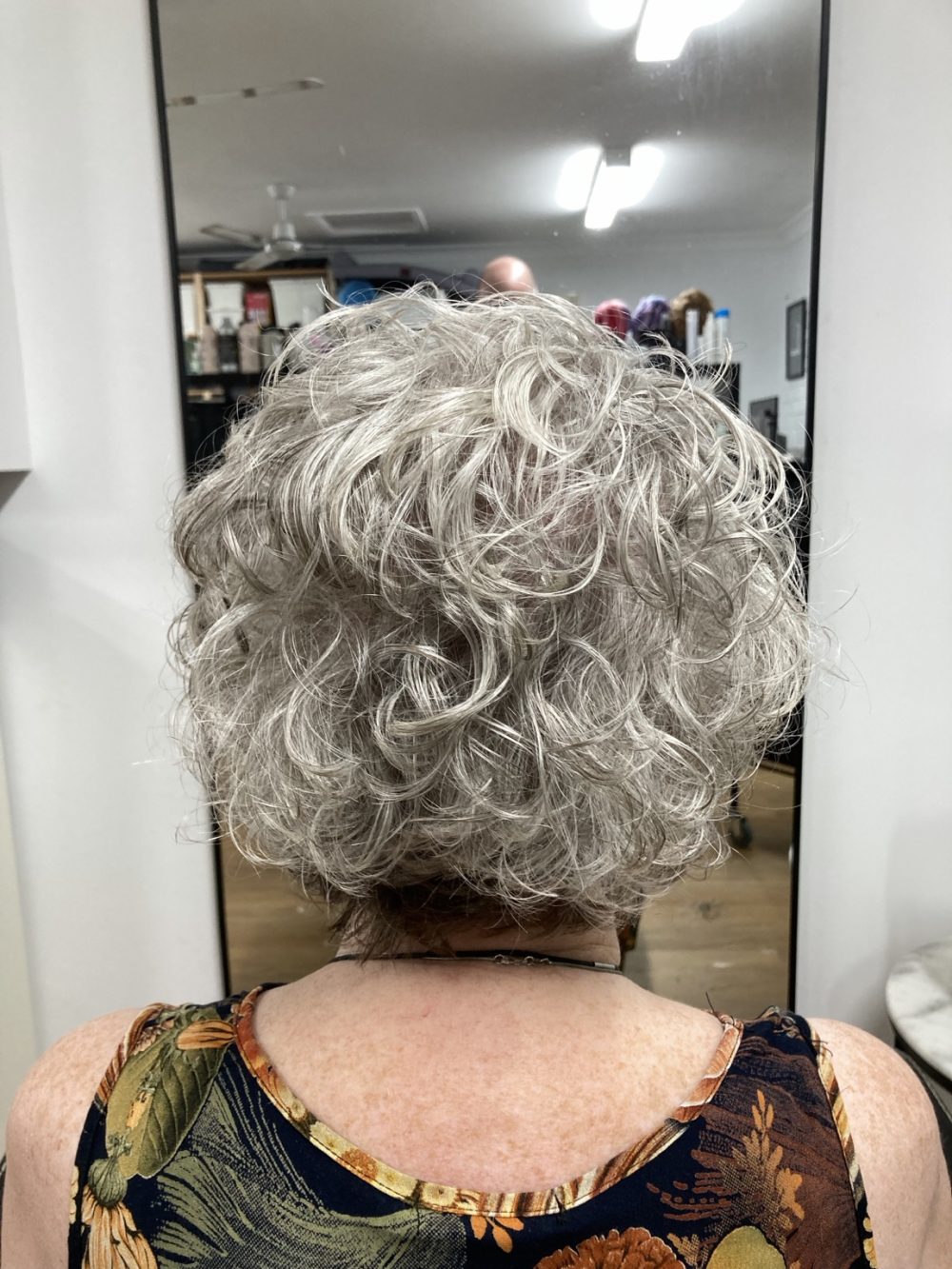
For women embracing their natural silver curls, this can be an opportunity to reconsider both their haircut and their haircare routine.
Within the Shizen philosophy, this reflects Mono no Aware (物の哀れ) — an appreciation of change and the beauty found within it.
Rather than fighting every change in our hair, we can learn to understand and work with what it’s becoming.
Embracing what you’re becoming.
Your Curls Don’t Need to Be Perfect
Perhaps the most important thing I’d like you to understand is that beautiful curly hair doesn’t have to be completely frizz-free.
Natural curls have movement, softness and individuality.
Some days they’ll be more defined.
Other days they’ll have greater volume.
And sometimes the weather will have its own ideas.
That doesn’t mean your hair is unhealthy or that you’ve failed to style it properly.
My belief is that beautiful hair should feel naturally yours.
Not forced.
Not unnecessarily complicated.
And certainly not dependent on achieving perfection every morning.
The goal isn’t to control every curl. It’s to understand how to bring out the best in them.
Experience the Shizen Method in Brisbane Northside
At my private one-to-one hair atelier in Deception Bay, I offer a considered approach to haircutting for women with straight, wavy, curly and coily hair.
With more than 40 years of hairdressing and education experience, my focus is on creating natural, wearable shapes that respect your hair’s individuality.
Whether you’re struggling with frizz, finding your curls difficult to manage or simply looking for a hairdresser who takes the time to understand your texture, the conversation begins with your hair and how you live with it. Explore my Curly Hair Specialist Brisbane Northside service.
The Shizen Cut — $150
A personalised haircut guided by your natural texture, movement and individual characteristics.
Welcoming clients from Deception Bay, North Lakes, Rothwell, Redcliffe, Mango Hill, Caboolture and surrounding Brisbane Northside communities.
Private appointments available Saturdays.
Discover the Shizen Method and Book Your Appointment
Beauty as a craft. Kindness as a mission.
Enjoyed this article?