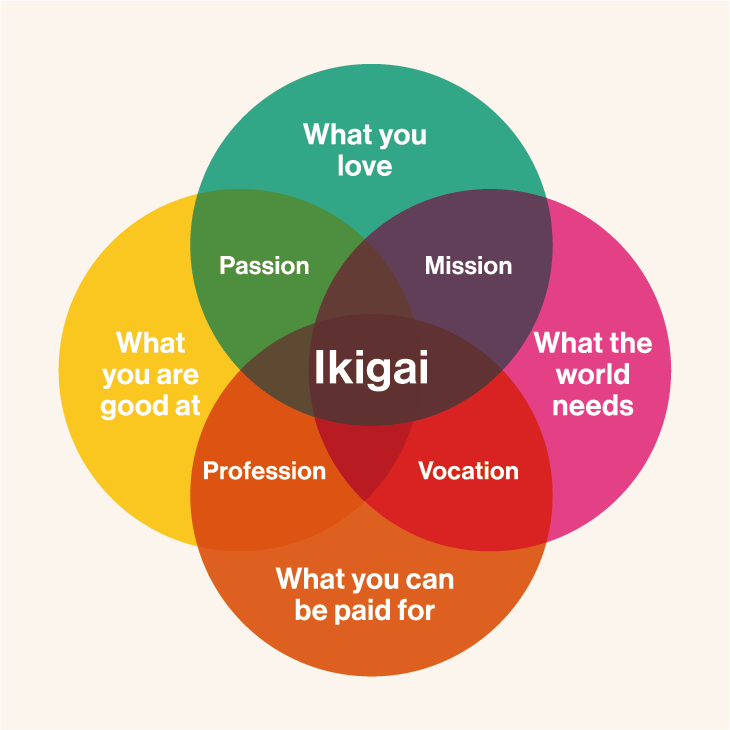
Many hairdressers reach a point where technical skill alone no longer answers the question, “What kind of work do I want to build my life around?” Ikigai is a Japanese term commonly translated as a reason for being or what makes life feel worth living. It has a range of meanings in Japanese life; it is not a prescribed career formula.
The familiar four-circle diagram that asks what you love, what you are good at, what the world needs and what you can be paid for is a modern career-planning device often associated with ikigai. It can be useful as a set of prompts, but it should not be presented as the definitive Japanese meaning of the term or a guaranteed route to success.
Use the questions as prompts, not a test
For a hairdresser, the questions may help organise a reflection:
- Which parts of the work hold your attention?
- What skills have you developed through practice, and where do you still need to learn?
- What do clients in your community ask for or struggle to find?
- What kind of work can support a sustainable business and a life you want?
The answers do not need to form a perfect intersection. A service can be meaningful without becoming your entire identity. A popular service may not suit your strengths or working conditions. Training, location, health, family commitments, financial needs and opportunity all shape what is practical.
Specialisation is a choice with trade-offs
Focusing on a particular area can help direct your education and make your offer easier for clients to understand. It also takes time to build skill and trust. Before investing heavily in a new niche, look at local demand, the equipment and training required, the appointment time and price needed to make the work viable, and whether you enjoy doing it repeatedly.
You do not need to claim expertise before you have earned it. A more honest path is to describe the skills you currently offer, keep learning, and review what clients value and what the business can sustain. Your focus may change as your experience and circumstances change.
Return to the work itself
When your direction feels unclear, notice which appointments leave you curious, which problems you enjoy solving, and where clients respond to the care you bring. Ask a trusted colleague for specific feedback. Track enquiries and repeat bookings rather than relying only on an idea of what the market wants. These observations will not make the decision for you, but they can make the next experiment smaller and more informed.
For me, the lasting purpose in hairdressing is found in the practice: paying attention, developing craft and helping each person find a result that feels right for them. I explore how observation informs my Shizen Method in a separate article. Ikigai can be a reflective prompt on that journey, without needing to turn it into a marketing formula.
Enjoyed this article?