A Softer, More Refined Way to Blend Grey
There is a moment many women reach where traditional hair colour no longer feels quite right.
The routine becomes predictable.
The regrowth line becomes more noticeable.
And the result—while technically correct—can begin to feel heavy.
For years, the industry has approached grey hair with a single objective:
cover it completely
But what if that approach is no longer the most refined option?
What if the goal was not to erase grey…
but to soften it, blend it, and integrate it into something more natural?
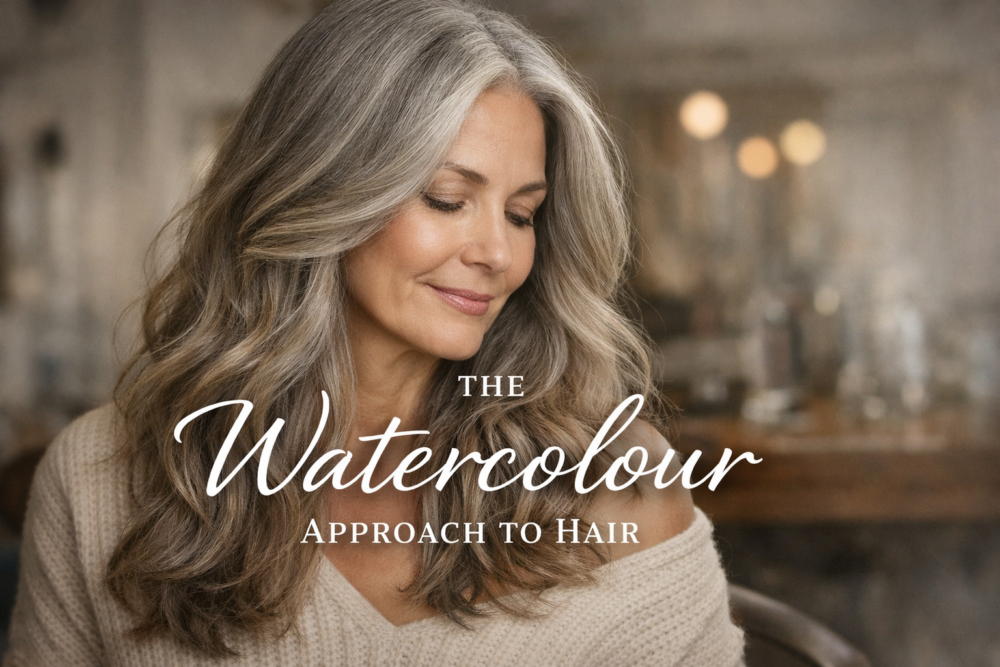
This is where the watercolour approach to hair begins.
What Is Watercolour Hair?
The term watercolour hair was originally introduced by Beth Minardi, drawing inspiration from the way watercolour paint behaves on paper.
Unlike opaque paint, watercolour is:
• soft
• translucent
• layered
• light-reflective
It allows what sits beneath it to remain visible, creating depth through transparency rather than density.
Applied to hair, this means:
• colour is layered instead of applied heavily
• tones are blended instead of blocked
• grey is softened instead of completely covered
The result is hair that feels more natural, more modern, and far more forgiving as it grows.
Why Traditional Grey Coverage Can Feel Heavy
Traditional colour techniques are designed to create full, even coverage.
While this is effective, it often leads to:
• a solid, uniform colour
• a visible regrowth line
• the need for frequent appointments
• a result that can feel flat or overly dense
For many women, this begins to feel like a cycle that is difficult to step away from.
Every few weeks, the same process repeats.
Not because the hair looks bad—
But because the line of regrowth becomes too obvious to ignore.
A Softer Alternative: Grey Integration
The watercolour approach introduces a different idea:
grey integration
Rather than trying to eliminate every grey hair, the focus shifts to:
• softening contrast
• layering tones
• creating dimension
• allowing some natural variation to remain
This creates a far more seamless grow-out.
Instead of a defined line, the transition becomes soft and diffused.
How Watercolour Colour Is Created
The process itself is more considered and often more refined.
Rather than a single colour application, the hair is treated as a composition of tones.
This may include:
• soft root diffusion to blur regrowth
• gentle light placement to reflect light naturally
• tonal layering through the mid-lengths
• sheer glossing to refine and enhance shine
Each element works together to create a result that feels balanced and effortless.
Importantly—
Nothing appears overdone.
Designed to Grow Beautifully Over Time
One of the most noticeable differences with this approach is what happens after you leave the salon.
Traditional colour often looks best in the first week.
Watercolour colour is designed to still look beautiful weeks later.
Many clients find they can move from:
• 3–4 week appointments
to
• 6–8 weeks, sometimes longer
Not because they are stretching their colour—
But because the colour has been designed to evolve naturally.
A More Modern Expression of Colour
There is a quiet shift happening in how women want their hair to feel.
Less structured.
Less forced.
More in harmony with who they are now.
Watercolour hair reflects this.
It offers:
• softness instead of harshness
• movement instead of flat colour
• dimension instead of uniformity
• longevity instead of constant maintenance
It is not about doing less.
It is about doing things with greater intention.
Is This Approach Right for You?
This approach is particularly suited to women who:
• are beginning to see grey and want a softer alternative to full coverage
• feel their current colour looks too dense or heavy
• want fewer, more considered salon visits
• prefer natural, elegant results over trend-driven colour
It is not about abandoning colour—
It is about refining it.
The Philosophy Behind the Work
At its core, this approach is guided by a simple idea:
Hair should not look heavily coloured.
It should look composed.
Soft.
Layered.
Evolving.
A reflection of time, not a resistance to it.
If you’re curious how this philosophy is applied in practice, you can explore the Private Atelier here:
Enjoyed this article?