Low Maintenance Hair Means Doing Less to It
The Truth
“Low maintenance” has become one of the most requested outcomes in hair.
Less upkeep.
Fewer appointments.
Less time spent styling.
And naturally, this leads to a simple assumption:
That achieving low maintenance hair means doing less.
Less cutting.
Less colouring.
Less attention overall.
But in reality, the opposite is often true.
Low maintenance hair is not created by doing less.
It is created by doing the right things—precisely.
Why This Myth Exists
From the outside, low maintenance hair appears effortless.
It grows well.
It holds its shape.
It doesn’t demand constant attention.
So it’s easy to assume that minimal effort created it.
But what you are seeing is not a lack of work.
It is the result of thoughtful work done at the right time.
With the right intention.
The Expert Insight
Hair becomes high maintenance when it is constantly being corrected.
Colour that doesn’t grow out well.
Haircuts that collapse quickly.
Shape that requires daily styling to hold.
Each of these creates a need for ongoing effort.
Not because the hair is difficult.
But because the foundation was not designed for longevity.
Low maintenance hair is built differently.
It is designed to evolve.
To grow without harsh lines.
To maintain balance as it changes.
To require minimal intervention between appointments.
This is where systems like Pure Colour become essential.
Because they allow colour to be applied in a way that softens over time, rather than creating a rigid result that needs constant upkeep.
The Role of Planning
True low maintenance hair is not reactive.
It is planned.
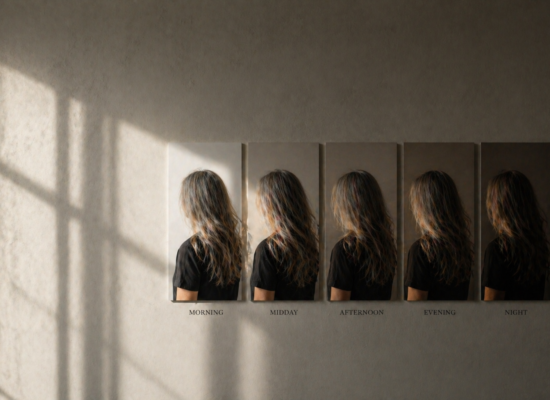
The placement of colour considers how it will look in weeks—not just today.
The haircut is designed to hold its structure as it grows.
Weight is distributed intentionally.
Movement is built in from the beginning.
This is not about doing less.
It is about thinking further ahead.
The Role of Haircutting
Haircutting is where low maintenance truly begins.
Through the Shizen method, hair is cut in its natural state.
Where it lives.
How it falls.
How it moves without interference.
This allows the shape to remain intact as it grows.
Instead of collapsing or becoming unbalanced, the haircut evolves.
And when the structure holds, styling becomes minimal.
Because the hair already knows where to go.
The Role of Colour
Colour must support this same philosophy.
Heavy, uniform colour creates maintenance.
Soft, dimensional colour reduces it.
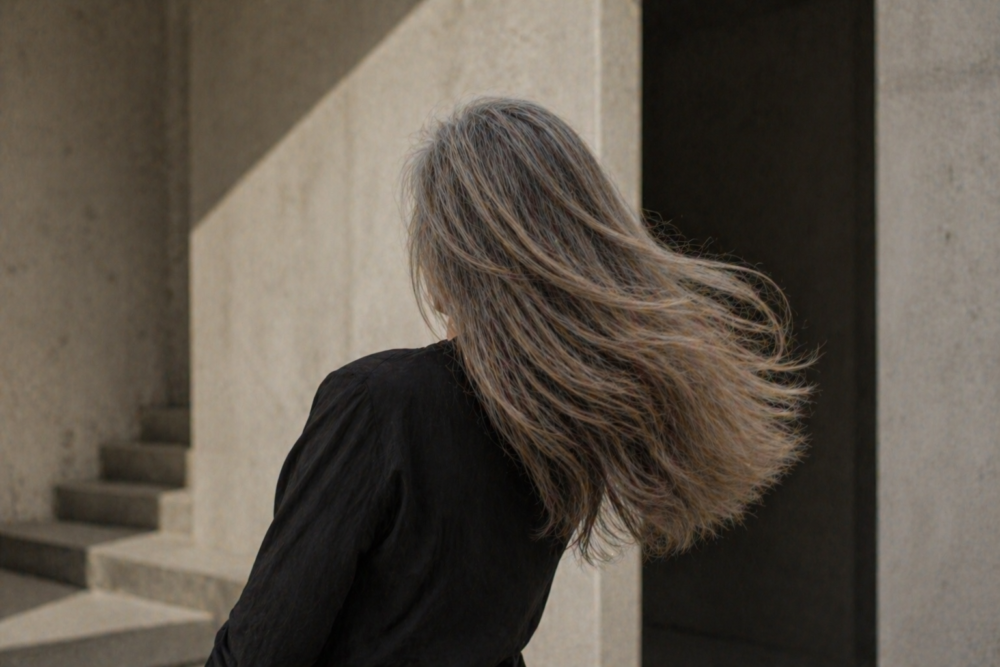
When grey is blended rather than fully covered, regrowth becomes less defined.
When tone is layered instead of saturated, it fades more naturally.
This reduces the urgency of appointments.
And allows the hair to move through time more gracefully.
What Low Maintenance Actually Looks Like
It does not mean neglect.
It means:
- fewer, more intentional appointments
- colour that softens rather than grows out harshly
- haircuts that maintain their integrity
- styling that enhances, not controls
It feels easy.
But it is built on precision.
The Philosophy
There is a difference between simplicity and carelessness.
Low maintenance hair is not about abandoning care.
It is about refining it.
Doing what is necessary.
And nothing more.
This aligns closely with the philosophy of Wabi Sabi.
Where beauty is found in things that are allowed to evolve.
Not forced to remain unchanged.
A Different Way to Think About It
Instead of asking:
“How can I do less to my hair?”
A more useful question is:
“How can my hair require less from me?”
Because when the approach changes, the experience changes.
Hair becomes something that supports you.
Not something you are constantly managing.
Closing
If you’re curious how this approach is applied in practice, you can explore the Private Atelier here:
Enjoyed this article?