You Should Match Your Old Hair Colour When Covering Grey
The Truth
This belief feels deeply personal.
When grey appears, the instinct is to return to what was.
The colour you had in your 20s.
The tone that felt familiar.
The version of yourself you recognise.
So the goal becomes simple:
Match it exactly.
But here is where the problem begins.
Because your hair has changed.
Your skin has changed.
The way light interacts with your features has changed.
And trying to recreate the past often creates something that feels… slightly off.
Not wrong.
But not quite right either.
Why This Myth Exists
Hair colour has long been positioned as a way to restore.
To bring things back to how they were.
And emotionally, that makes sense.
Familiarity feels safe.
Predictable.
Reassuring.
But hair is not static.
It evolves.
And when we attempt to hold it in a previous state, we ignore what it needs now.
The Expert Insight
Natural hair colour is rarely one solid tone.
Even in younger years, it contains variation.
Subtle shifts in depth.
Lightness around the face.
Movement created by natural highlights.
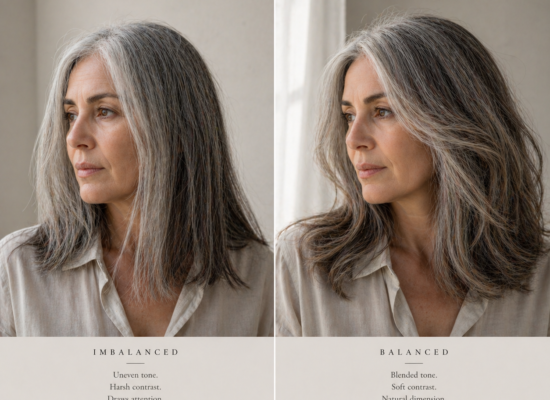
When you attempt to match your “original colour” using a single formula, you remove that variation.
The result becomes:
- flatter
- more uniform
- less responsive to light
And this is where it can begin to feel less natural than intended.
Because natural colour is not defined by exactness.
It is defined by variation.
Why It Often Looks Too Dark
One of the most common outcomes of trying to match previous colour is going too deep.
Not dramatically.
But just enough.
And that small shift can change everything.
Darker colour absorbs more light.
It creates a stronger frame around the face.
It reduces softness.
This is why many people feel that their hair looks heavier over time.
Not because grey has appeared.
But because the colour has gradually deepened in an attempt to cover it.
A More Refined Approach
Instead of asking:
“How do we get back to what it was?”
A more useful question is:
“What does this hair need now to feel balanced?”
Because balance is what creates a natural result.
Not replication.
This is where modern systems like Pure Colour allow for a different approach.
Rather than forcing the hair into a single tone, colour is layered.
Depth is placed where it is needed.
Light is preserved where it creates softness.
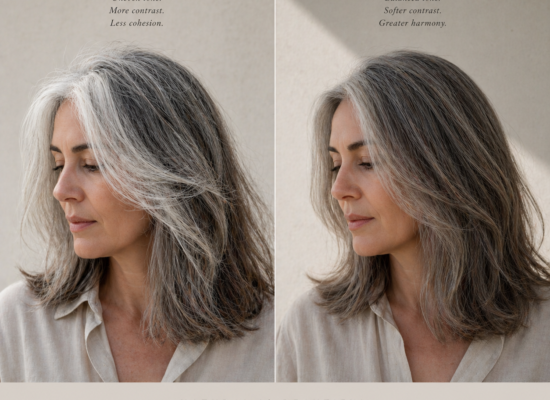
Grey is integrated rather than eliminated.
The result feels closer to natural—not because it matches the past, but because it respects the present.
The Role of Grey
Grey hair changes how colour behaves.
It reflects light differently.
It creates natural contrast.
It introduces variation that did not exist before.
When used correctly, this can enhance the overall result.
Grey can soften the colour.
Break up density.
Add a sense of movement without additional lightening.
But only if it is allowed to participate.
Not suppressed completely.
The Role of Shape
Haircutting plays a critical role here.
Because when colour becomes more subtle, shape becomes more important.
Through the Shizen method, the structure of the hair is designed to support natural variation.
Weight is balanced.
Movement is intentional.
The hair falls in a way that allows light and tone to interact.
This is what creates a result that feels complete.
Not because everything is the same.
But because everything works together.
The Philosophy
This belief—that we should return to what was—is rooted in attachment.
A desire to hold onto a fixed version of ourselves.
But refinement is not about returning.
It is about evolving with intention.
Hair offers an opportunity to do that.
To adjust.
To refine.
To create something that feels aligned now.
Not then.
A Different Perspective
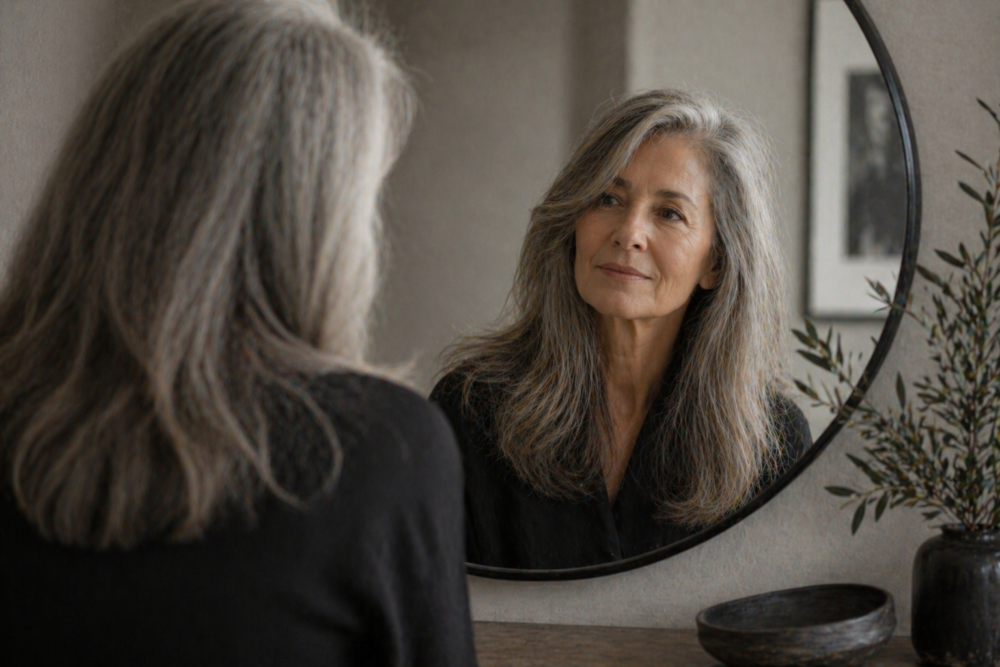
When you stop trying to recreate your old colour, something opens up.
There is more flexibility.
More softness.
More opportunity to create something that feels effortless.
Because the goal shifts.
From matching…
To composing.
And that shift is where elegance begins.
Closing
If you’re curious how this approach is applied in practice, you can explore the Private Atelier here:
Enjoyed this article?