There is a certain allure to blonde hair.
It is often described as light, luminous, effortless.
A colour associated with brightness and refinement.
And yet, for something so widely desired, blonde is also one of the most misunderstood.
Because there is a quiet assumption that sits beneath the idea of blonde:
That there is a version of it that is universally flattering.
A “perfect blonde.”
But in practice, this rarely exists.
The Illusion of a Universal Shade
You may have seen a blonde on someone else and thought:
“That’s exactly what I want.”
A photo is saved. A reference is shared. A direction is set.
And yet, even when the tone is replicated with precision, the result can feel… different.
Not wrong.
But not quite the same.
This is not a technical limitation.
It is a misunderstanding of what colour truly is.
Colour Is Not Absolute
We often think of colour as fixed.
A shade. A formula. A result.
But colour is never experienced in isolation.
It is always influenced by what surrounds it.
Your skin tone.
Your eye colour.
Your natural depth.
The way light reflects across your features.
This means that blonde is not a single destination.
It is a relationship.
The Role of Contrast
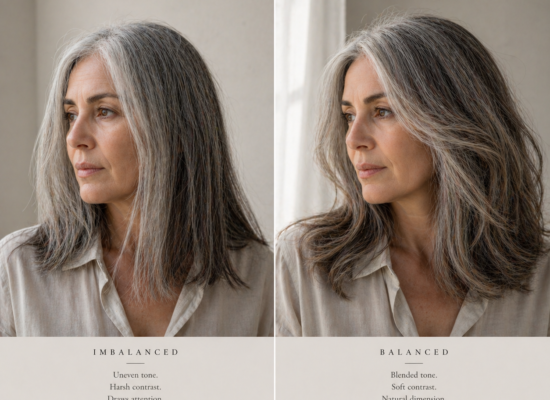
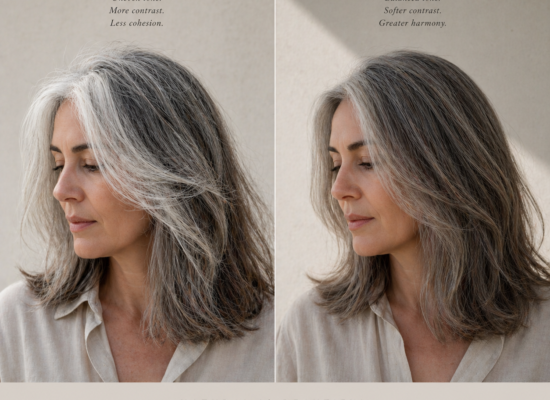
One of the most defining factors in how blonde appears is contrast.
A lighter blonde on someone with naturally high contrast can feel striking, even dramatic.
The same blonde on someone with softer, lower contrast may feel overpowering.
In one case, the colour enhances.
In the other, it competes.
Neither is inherently right or wrong.
But only one will feel harmonious.
Depth: The Subtle Difference That Changes Everything
Blonde exists across a wide spectrum of depth.
From soft, understated beige tones
To brighter, lighter, almost reflective finishes
Choosing the right depth is often more important than choosing the right tone.
A blonde that is too light can wash out the skin.
Too deep, and it can lose the very quality that defines it.
The balance is subtle.
But when it is right, it feels effortless.
Softness vs Brightness
Another layer often overlooked is the level of softness or clarity in the colour.
Some blondes are muted. Gentle. Almost diffused.
Others are bright. Clean. Highly reflective.
If the clarity of the blonde does not match the clarity of your natural features, the result can feel disconnected.
A soft face with a very bright blonde can feel overwhelmed.
A clear, defined face with a muted blonde can feel dulled.
Again, this is not about preference.
It is about alignment.
Why Reference Images Can Mislead
Reference images are helpful—but they come with limitations.
They show a moment.
A person.
A set of features that are not your own.
When we aim to recreate a blonde exactly as it appears on someone else, we ignore the relational nature of colour.
The result may be technically accurate.
But emotionally, it can feel unfamiliar.
A More Personal Approach to Blonde
Rather than asking:
“What blonde do I want?”
The more useful question becomes:
“What blonde works with me?”
This is where personal colour analysis becomes essential.
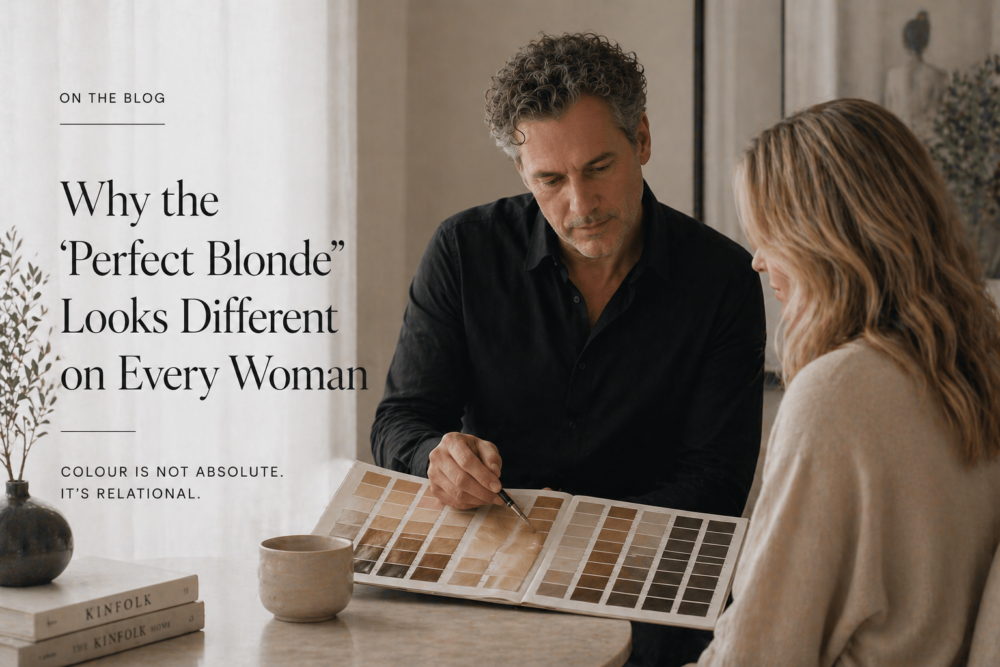
Using tools such as The Colourist Board, we can observe how different variations of blonde interact with your natural palette.
Not just in theory—but in real time.
This allows us to refine:
- The depth of the blonde
- The balance of warmth and coolness
- The level of softness or clarity
Until the colour feels cohesive.
Before choosing your next shade, explore your colouring with my free Seasonal Colour Quiz. Your downloadable one-page guide suggests a season, hair colour level and hue to discuss in consultation, helping you consider whether blonde—or another colour direction—may suit your features and preferences.
When Blonde Feels Right
The difference is often quiet.
But unmistakable.
Your skin appears more even.
Your eyes feel brighter.
The colour integrates, rather than sitting on top.
It doesn’t ask for attention.
It supports everything else.
Moving Away from “Perfect”
The idea of a “perfect blonde” suggests that there is one ideal to aim for.
But in reality, the most refined results are not universal.
They are personal.
The right blonde is not the lightest.
Or the coolest.
Or the most expensive.
It is the one that feels like a natural extension of you.
A Philosophy of Harmony
This approach to colour is less about transformation, and more about alignment.
It is guided by restraint.
By observation.
By a respect for what already exists.
This is where the philosophy of Wabi Sabi quietly shapes the work.
Beauty not as something to impose, but something to reveal.
A Final Thought
If you have ever searched for the “perfect blonde,” it is understandable.
We are often taught to look outward for inspiration.
But the most meaningful direction is inward.
Because blonde is never just a colour.
It is a relationship between tone, light, and the person wearing it.
And when that relationship is right, the result is not just beautiful.
It is effortless.
If you’re curious how this philosophy is applied in practice, you can explore the Private Atelier here:
Enjoyed this article?