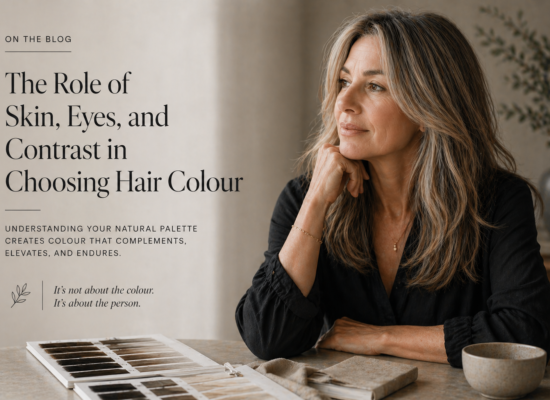
Transitioning to grey hair is a personal choice. At my private atelier in Deception Bay, the starting point is how much grey you want to see and how you want your hair to look while it grows. There is no single transition plan that suits every head of hair.
You might want to stop colouring, soften the line between coloured lengths and new growth, or simply understand your options. Choosing complete grey coverage remains equally valid. The decision belongs to you.
Plan the grow-out before changing the colour
The contrast between your natural roots and coloured lengths matters. So do previous permanent colour, the distribution of white hair, your preferred length and the condition of the ends. We discuss those details before deciding whether to preserve the existing colour, refine the tone or consider selective blending.
Blending can soften a visible transition; it does not stop regrowth or guarantee an invisible line. A move from dark colour to natural silver may need several stages. I will discuss what is realistic after seeing your hair, rather than promise a one-visit result.
Three ways to transition from permanent colour to natural grey
There is more than one way to move away from regular permanent colour. The right choice depends on how much contrast you are comfortable seeing, the depth of the colour already in your hair and its condition.
- Grow it out naturally: stop colouring and let your own pattern emerge. This avoids further colour processing but makes the boundary between new growth and previously coloured lengths more visible.
- Soften the transition: carefully placed blending or tonal refinement may reduce the contrast. This is not always achievable in one appointment, particularly over dark permanent colour.
- Transition in stages: gradually adjust the colour and haircut over several visits, allowing more of your natural grey to become visible while managing the older coloured lengths.
Existing permanent pigment cannot simply be washed away to reveal untouched silver underneath. Lightening or removing artificial colour can expose warmth and affect condition, so I assess the hair before recommending any corrective process. Read more about soft grey blending and how blending differs from complete coverage.
How long does growing out grey hair take?
Hair commonly grows around a centimetre per month, although individual rates vary. That means replacing 12 centimetres of previously coloured length with natural growth might take roughly a year; replacing longer lengths can take considerably more time. Regular cutting can shorten the visible transition, but you do not have to sacrifice length if you prefer a slower approach.
The visible result also depends on where your grey is concentrated, how dark the existing colour is and whether we choose to blend the boundary. A realistic plan should be based on your hair today, not a promised deadline or a dramatic before-and-after photograph.
Care for the hair you have
Grey hair is not automatically coarse, dry or damaged. Choose cleansing and conditioning around how your scalp and hair actually feel. Fine silver hair may need a lighter conditioner, while coarser or previously lightened lengths may benefit from more conditioning.
Wash often enough to keep your scalp comfortable and remove product build-up. Apply conditioner where it is needed, detangle gently and assess the result before adding another treatment. There is no fixed washing or treatment schedule for everyone.
Keeping silver tones clear
If unwanted yellow tones appear, a violet shampoo may help adjust their appearance. Follow the product instructions and use it according to the tone you see, rather than automatically at every wash. Too much pigment can leave pale hair looking violet or dull. Persistent discolouration is a reason to assess the cause before adding more toner.
For days outdoors around Moreton Bay, a hat provides a practical barrier from direct sun. After swimming, rinse your hair and follow a cleansing and conditioning routine suited to it. Use heat protection when heat styling and avoid unnecessary repeated passes.
Keep shape and natural movement in the plan
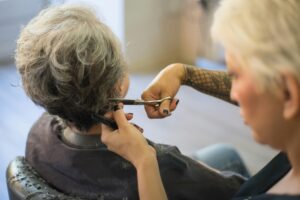
You do not have to cut your hair short because it is grey. Length, density and proportion guide the shape. A trim can remove weathered ends while preserving the length you value; the return interval should follow how the haircut is holding up.
If your hair is wavy or curly, my approach to natural curls considers spring, weight and how the hair settles when dry. Colour and cut should support the same result.
A considered haircut makes the transition feel intentional
As the colour changes, we can refine the outline, movement and weight distribution so your hair looks deliberately shaped at every stage. A precise bob, soft graduation or longer layers can all work with grey hair; the choice comes from your density, texture, face and preferred styling routine, not your age. The aim is to preserve a sense of you while the colour evolves.
For colour refinement alone, the Colour Refinement Session ($200) may be appropriate. If colour and shape both need attention, consider the Full Atelier Session ($300). Significant colour removal or correction needs a separate discussion before booking to confirm what is feasible.
Discuss your grey transition in Deception Bay
I work one-to-one at Anthony Presotto Private Atelier, 20 Mariner Blvd, Deception Bay QLD 4508, for guests from Moreton Bay and Brisbane Northside. Saturday appointments run from 8 am–4 pm, by appointment only.
Read the current atelier services and prices. If you are moving away from existing colour, call 0412 672 246 before booking so we can discuss the right starting point. You can also book your atelier appointment online.
Enjoyed this article?